
Join Our JEE Preparation Group
Prep with like-minded aspirants; Get access to free daily tests and study material.
Sign in
Please select an account to continue using cracku.in
↓ →
Join Our JEE Preparation Group
Prep with like-minded aspirants; Get access to free daily tests and study material.
Let the Mean and Variance of five observations $$x_1 = 1, x_2 = 3, x_3 = a, x_4 = 7$$ and $$x_5 = b$$, $$a \gt b$$, be 5 and 10 respectively. Then the Variance of the observations $$n + x_n$$, $$n = 1, 2, \ldots, 5$$ is
The five given observations are $$x_1 = 1,\; x_2 = 3,\; x_3 = a,\; x_4 = 7,\; x_5 = b$$ with $$a \gt b$$.
Their mean is given to be $$5$$, so
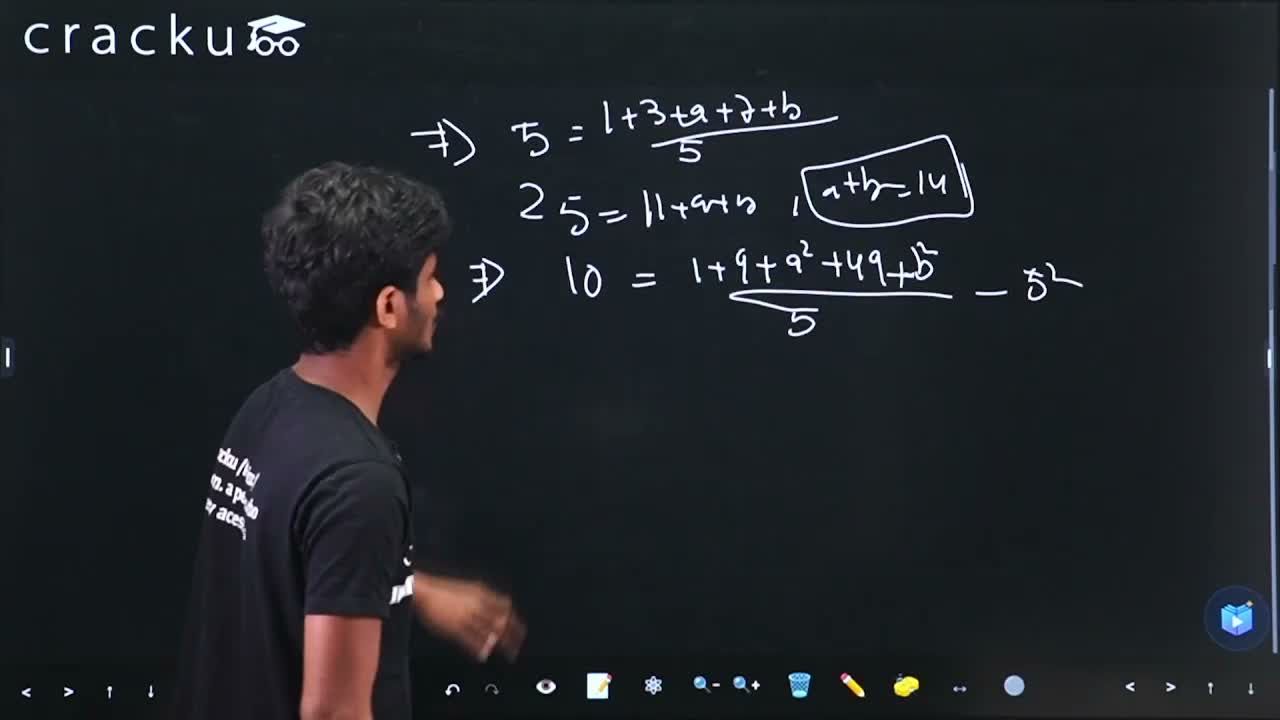
$$\frac{1 + 3 + a + 7 + b}{5} = 5 \; \Longrightarrow \; 11 + a + b = 25 \; \Longrightarrow \; a + b = 14 \; -(1)$$
The variance is given to be $$10$$. For a population of five values,
$$\text{Variance} = \frac{1}{5}\sum_{i=1}^{5}(x_i - \mu)^2 = 10,\quad \mu = 5.$$
Compute the three known squared deviations:
$$(1-5)^2 = 16,\; (3-5)^2 = 4,\; (7-5)^2 = 4.$$
Let $$S = (a-5)^2 + (b-5)^2$$. Then
$$\frac{16 + 4 + 4 + S}{5} = 10 \; \Longrightarrow \; 24 + S = 50 \; \Longrightarrow \; S = 26 \; -(2)$$
Expand $$S$$ using $$a + b = 14$$:
$$S = (a-5)^2 + (b-5)^2 = a^2 - 10a + 25 + b^2 - 10b + 25 \\ = (a^2 + b^2) - 10(a + b) + 50.$$
Since $$a^2 + b^2 = (a + b)^2 - 2ab = 196 - 2ab$$,
$$S = 196 - 2ab - 140 + 50 = 106 - 2ab.$$
Using $$S = 26$$ from $$(2)$$,
$$106 - 2ab = 26 \; \Longrightarrow \; 2ab = 80 \; \Longrightarrow \; ab = 40 \; -(3)$$
Equations $$(1)$$ and $$(3)$$ give the quadratic
$$t^2 - 14t + 40 = 0 \quad (\text{with roots } a,\,b).$$
Discriminant $$D = 196 - 160 = 36 \;\;\Longrightarrow\;\; t = \frac{14 \pm 6}{2} = 10 \text{ or } 4.$$
Since $$a \gt b$$, we have $$a = 10,\; b = 4.$$
The original data are therefore $$1,\,3,\,10,\,7,\,4.$$
Now form the new observations $$n + x_n$$ for $$n = 1,2,\ldots,5$$:
$$\begin{aligned} n=1 &: 1 + 1 = 2\\ n=2 &: 2 + 3 = 5\\ n=3 &: 3 + 10 = 13\\ n=4 &: 4 + 7 = 11\\ n=5 &: 5 + 4 = 9 \end{aligned}$$
Thus the new set is $$2,\,5,\,13,\,11,\,9.$$
Mean of the new set:
$$\bar{y} = \frac{2 + 5 + 13 + 11 + 9}{5} = \frac{40}{5} = 8.$$
Compute squared deviations from $$8$$:
$$ (2-8)^2 = 36,\; (5-8)^2 = 9,\; (13-8)^2 = 25,\; (11-8)^2 = 9,\; (9-8)^2 = 1.$$
Sum of squared deviations $$= 36 + 9 + 25 + 9 + 1 = 80.$$
Variance (population) $$= \frac{80}{5} = 16.$$
Therefore, the variance of the observations $$n + x_n$$ is $$16$$.
Option D is correct.
Was this solution helpful?
Click on the Email ☝️ to Watch the Video Solution
Create a FREE account and get:
_1.webp)

Educational materials for JEE preparation

Ask our AI anything

AI can make mistakes. Please verify important information.
AI can make mistakes. Please verify important information.
