
Join Our JEE Preparation Group
Prep with like-minded aspirants; Get access to free daily tests and study material.
Sign in
Please select an account to continue using cracku.in
↓ →
Join Our JEE Preparation Group
Prep with like-minded aspirants; Get access to free daily tests and study material.
Let $$a_1, a_2, a_3, \ldots$$ be an A.P. and $$g_1 = a_1, g_2, g_3, \ldots$$ be an increasing G.P. If $$a_1 = a_2 + g_2 = 1$$ and $$a_3 + g_3 = 4$$, then $$a_{10} + g_5$$ is equal to :
The arithmetic progression is $$a_1,a_2,a_3,\ldots$$ with common difference $$d$$, so $$a_n = a_1 + (n-1)d$$.
The geometric progression is $$g_1,g_2,g_3,\ldots$$ with common ratio $$r$$, and we are told $$g_1 = a_1$$. Hence $$g_n = g_1\,r^{\,n-1} = r^{\,n-1}$$ because $$g_1 = a_1 = 1$$.
First condition: $$a_1 = a_2 + g_2 = 1$$.
• $$a_2 = a_1 + d = 1 + d$$.
• $$g_2 = r$$.
• Therefore $$1 + d + r = 1 \;\Rightarrow\; d + r = 0 \;\Rightarrow\; r = -d$$. $$-(1)$$
Second condition: $$a_3 + g_3 = 4$$.
• $$a_3 = a_1 + 2d = 1 + 2d$$.
• $$g_3 = r^{\,2}$$.
• Hence $$1 + 2d + r^{\,2} = 4 \;\Rightarrow\; 2d + r^{\,2} = 3$$. $$-(2)$$
Substitute $$r = -d$$ from $$(1)$$ into $$(2)$$:
$$2d + (-d)^{2} = 3 \;\Rightarrow\; 2d + d^{2} = 3 \;\Rightarrow\; d^{2} + 2d - 3 = 0.$$
Solving the quadratic,
$$d = 1 \quad \text{or} \quad d = -3.$$
But $$r = -d$$ must satisfy $$r \gt 1$$ because the G.P. is increasing.
• If $$d = 1$$, then $$r = -1$$ (not > 1) - reject.
• If $$d = -3$$, then $$r = 3$$ (acceptable).
Thus $$d = -3$$ and $$r = 3$$.
Compute the required terms.
• Arithmetic term: $$a_{10} = a_1 + 9d = 1 + 9(-3) = 1 - 27 = -26.$$br/>
• Geometric term: $$g_5 = r^{\,4} = 3^{\,4} = 81.$$
Therefore, $$a_{10} + g_5 = -26 + 81 = 55.$$
Option D which is: 55
Was this solution helpful?
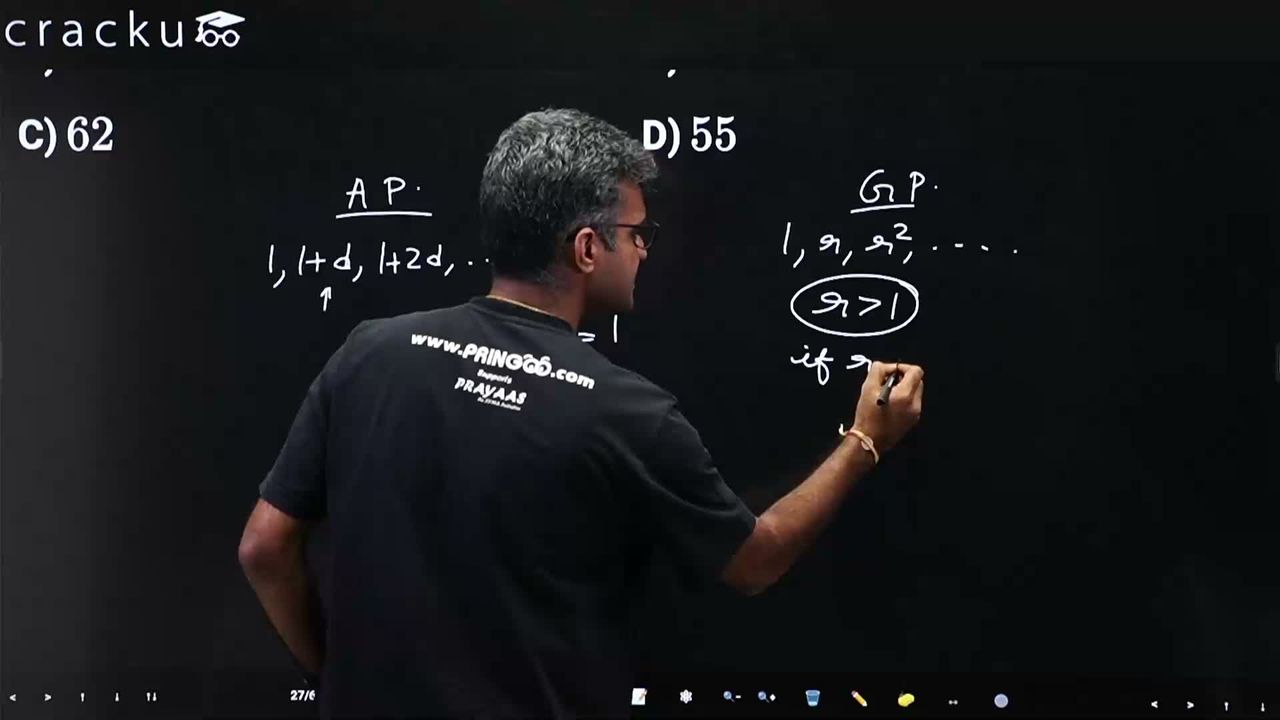
Click on the Email ☝️ to Watch the Video Solution
Create a FREE account and get:
_1.webp)

Educational materials for JEE preparation

Ask our AI anything

AI can make mistakes. Please verify important information.
AI can make mistakes. Please verify important information.
