
Join Our JEE Preparation Group
Prep with like-minded aspirants; Get access to free daily tests and study material.
Sign in
Please select an account to continue using cracku.in
↓ →
Join Our JEE Preparation Group
Prep with like-minded aspirants; Get access to free daily tests and study material.
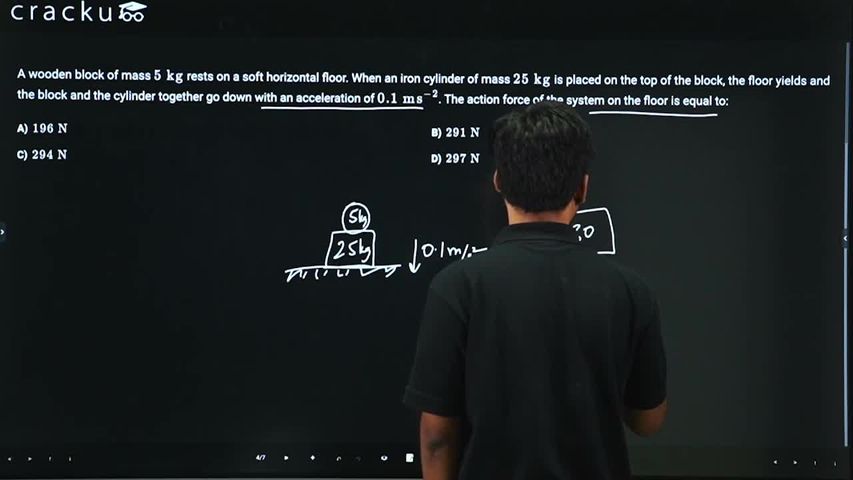
A wooden block of mass $$5 \text{ kg}$$ rests on a soft horizontal floor. When an iron cylinder of mass $$25 \text{ kg}$$ is placed on the top of the block, the floor yields and the block and the cylinder together go down with an acceleration of $$0.1 \text{ ms}^{-2}$$. The action force of the system on the floor is equal to:
A wooden block (5 kg) and iron cylinder (25 kg) go down together with acceleration $$a = 0.1$$ m/s$$^2$$.
The total mass is $$m = 5 + 25 = 30$$ kg.
According to Newton's second law, the system accelerates downward at $$0.1$$ m/s$$^2$$. The forces acting on the system are weight (downward) and the normal reaction from the floor (upward).
- Weight (downward): $$mg = 30 \times 9.8 = 294$$ N
- Normal reaction from floor (upward): $$N$$
According to Newton's second law,
$$ mg - N = ma $$
Therefore,
$$ N = mg - ma = m(g - a) = 30(9.8 - 0.1) = 30 \times 9.7 = 291 \text{ N} $$
By Newton's third law, the action force of the system on the floor equals $$N = 291$$ N downward.
The correct answer is Option (2): 291 N.
Was this solution helpful?
Click on the Email ☝️ to Watch the Video Solution
Create a FREE account and get:
_1.webp)

Educational materials for JEE preparation

Ask our AI anything

AI can make mistakes. Please verify important information.
AI can make mistakes. Please verify important information.
