
Join Our JEE Preparation Group
Prep with like-minded aspirants; Get access to free daily tests and study material.
Sign in
Please select an account to continue using cracku.in
↓ →
Join Our JEE Preparation Group
Prep with like-minded aspirants; Get access to free daily tests and study material.
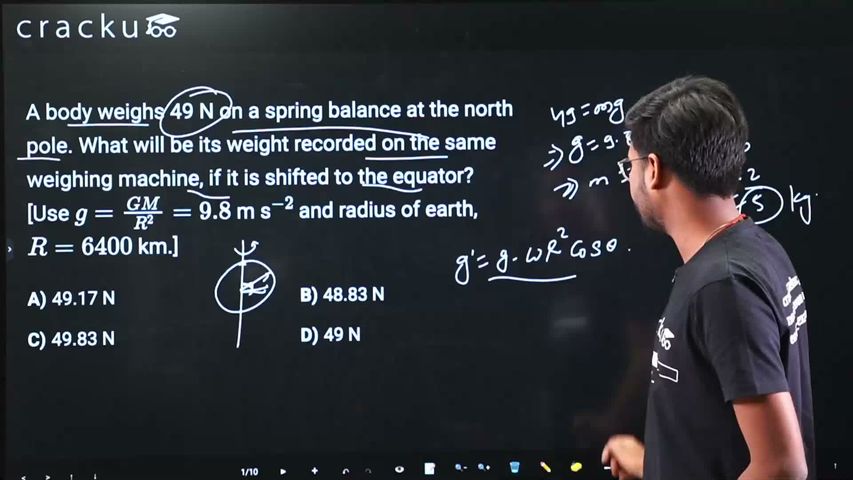
A body weighs 49 N on a spring balance at the north pole. What will be its weight recorded on the same weighing machine, if it is shifted to the equator?
[Use $$g = \frac{GM}{R^2} = 9.8$$ m s$$^{-2}$$ and radius of earth, $$R = 6400$$ km.]
At the north pole, the body weighs 49 N. Using $$W = mg$$, the mass of the body is $$m = \frac{49}{9.8} = 5$$ kg.
At the equator, the effective acceleration due to gravity is reduced because of Earth's rotation. The effective gravity at the equator is $$g' = g - R\omega^2$$, where $$R = 6400 \times 10^3$$ m is the radius of Earth and $$\omega = \frac{2\pi}{T}$$ is the angular velocity of Earth with $$T = 24 \times 3600 = 86400$$ s.
Calculating $$\omega = \frac{2\pi}{86400} = 7.27 \times 10^{-5}$$ rad/s. Then $$R\omega^2 = 6.4 \times 10^6 \times (7.27 \times 10^{-5})^2 = 6.4 \times 10^6 \times 5.285 \times 10^{-9} = 0.0338$$ m/s$$^2$$.
So the effective gravity at the equator is $$g' = 9.8 - 0.0338 = 9.766$$ m/s$$^2$$.
The weight at the equator is $$W' = mg' = 5 \times 9.766 = 48.83$$ N.
The correct answer is 48.83 N.
Was this solution helpful?
Click on the Email ☝️ to Watch the Video Solution
Create a FREE account and get:
_1.webp)

Educational materials for JEE preparation

Ask our AI anything

AI can make mistakes. Please verify important information.
AI can make mistakes. Please verify important information.


