
Join Our JEE Preparation Group
Prep with like-minded aspirants; Get access to free daily tests and study material.
Sign in
Please select an account to continue using cracku.in
↓ →
Join Our JEE Preparation Group
Prep with like-minded aspirants; Get access to free daily tests and study material.
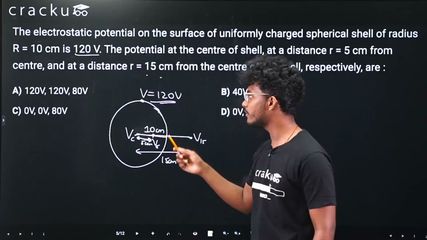
The electrostatic potential on the surface of uniformly charged spherical shell of radius R = 10 cm is 120 V. The potential at the centre of shell, at a distance r = 5 cm from centre, and at a distance r = 15 cm from the centre of the shell, respectively, are :
The shell is a thin, uniformly charged spherical shell of radius $$R = 10 \text{ cm} = 0.10 \text{ m}$$.
The given electrostatic potential on its surface is $$V(R)=120 \text{ V}$$.
Key electrostatics results for a uniformly charged thin spherical shell
1. For any point inside the shell ($$r \lt R$$): the electric field is zero, $$E=0$$, and the electrostatic potential is the same everywhere as on the surface. Hence $$V(r)=V(R)$$.
2. For any point outside the shell ($$r \gt R$$): the shell behaves as if all its charge were concentrated at its centre. Therefore $$V(r)=\dfrac{kQ}{r}$$, where $$Q$$ is the total charge and $$k=\dfrac{1}{4\pi\varepsilon_0}$$.
We use these two facts to find the required potentials.
Case 1: At the centre of the shell ( $$r = 0$$ )
Since $$r \lt R$$, the potential equals the surface potential: $$V(0)=V(R)=120 \text{ V}$$.
Case 2: At an interior point $$r = 5 \text{ cm} = 0.05 \text{ m}$$
Again $$r \lt R$$, so $$V(5\text{ cm})=V(R)=120 \text{ V}$$.
Case 3: At an exterior point $$r = 15 \text{ cm} = 0.15 \text{ m}$$
Here $$r \gt R$$, so use the point-charge formula.
The charge $$Q$$ is not given directly, but we can eliminate it using the known surface potential:
$$V(R)=\dfrac{kQ}{R}=120 \text{ V} \quad -(1)$$
For $$r = 0.15 \text{ m}$$, $$V(15\text{ cm})=\dfrac{kQ}{r}$$
Divide this by equation $$(1)$$ to remove $$Q$$:
$$\dfrac{V(15\text{ cm})}{120}=\dfrac{\dfrac{kQ}{r}}{\dfrac{kQ}{R}}=\dfrac{R}{r}$$
Hence
$$V(15\text{ cm})=120 \times \dfrac{R}{r}=120 \times \dfrac{0.10}{0.15}=120 \times \dfrac{2}{3}=80 \text{ V}$$.
Summary of potentials
Centre (0 cm): $$120 \text{ V}$$
Inside at 5 cm: $$120 \text{ V}$$
Outside at 15 cm: $$80 \text{ V}$$
These values match Option A: 120 V, 120 V, 80 V.
Was this solution helpful?
Click on the Email ☝️ to Watch the Video Solution
Create a FREE account and get:
_1.webp)

Educational materials for JEE preparation

Ask our AI anything

AI can make mistakes. Please verify important information.
AI can make mistakes. Please verify important information.


