
Join Our JEE Preparation Group
Prep with like-minded aspirants; Get access to free daily tests and study material.
Sign in
Please select an account to continue using cracku.in
↓ →
Join Our JEE Preparation Group
Prep with like-minded aspirants; Get access to free daily tests and study material.
Solute A associates in water. When $$0.7$$ g of solute A is dissolved in $$42.0$$ g of water, it depresses the freezing point by $$0.2°$$C. The percentage association of solute A in water, is
[Given: Molar mass of A $$= 93$$ g mol$$^{-1}$$. Molal depression constant of water is $$1.86$$ K kg mol$$^{-1}$$]
We are given that solute A associates in water and we need to find the percentage association.
Since the freezing point depression is given by $$\Delta T_f = K_f \times m$$, substituting $$\Delta T_f = 0.2$$ and $$K_f = 1.86$$ yields $$m = \frac{0.2}{1.86} = 0.1075 \text{ mol/kg}$$.
Without association, the theoretical molality is calculated using the mass of solute and solvent; thus, $$m_{\text{theoretical}} = \frac{0.7}{93 \times 0.042} = \frac{0.7}{3.906} = 0.1792 \text{ mol/kg}$$.
From the ratio of observed to theoretical molality, the van't Hoff factor is $$i = \frac{m_{\text{observed}}}{m_{\text{theoretical}}} = \frac{0.1075}{0.1792} = 0.6$$.
For a dimerization association where $$n = 2$$, the relation between $$i$$ and the fraction associated $$x$$ is $$i = 1 - x + \frac{x}{n} = 1 - x + \frac{x}{2} = 1 - \frac{x}{2}$$. Substituting $$i = 0.6$$ gives $$0.6 = 1 - \frac{x}{2}$$, which leads to $$\frac{x}{2} = 0.4$$ and hence $$x = 0.8$$ or 80\%.
Therefore, the percentage association of solute A in water is 80%, corresponding to Option D.
Was this solution helpful?
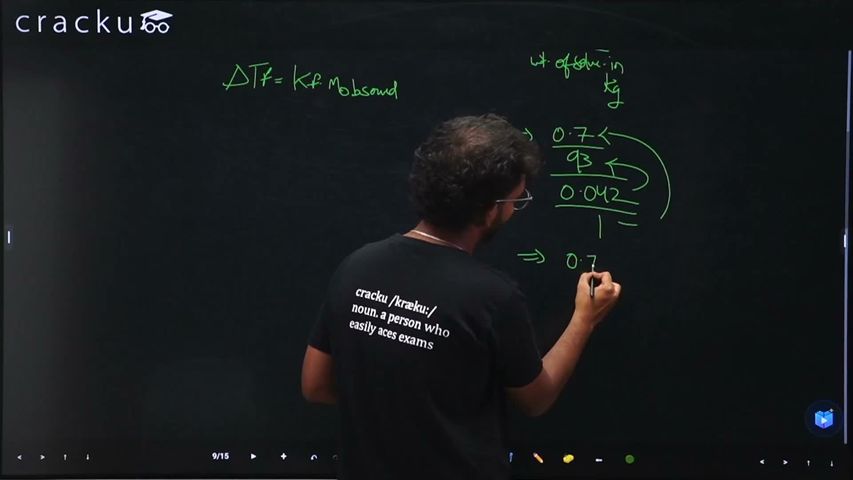
Click on the Email ☝️ to Watch the Video Solution
Create a FREE account and get:
_1.webp)

Educational materials for JEE preparation

Ask our AI anything

AI can make mistakes. Please verify important information.
AI can make mistakes. Please verify important information.


