
Join Our JEE Preparation Group
Prep with like-minded aspirants; Get access to free daily tests and study material.
Sign in
Please select an account to continue using cracku.in
↓ →
Join Our JEE Preparation Group
Prep with like-minded aspirants; Get access to free daily tests and study material.
Given below are two statements: one is labelled as Assertion and the other is labelled as Reason.
Assertion: A mixture contains benzoic acid and naphthalene. The pure benzoic acid can be separated out by the use of benzene.
Reason: Benzoic acid is soluble in hot water.
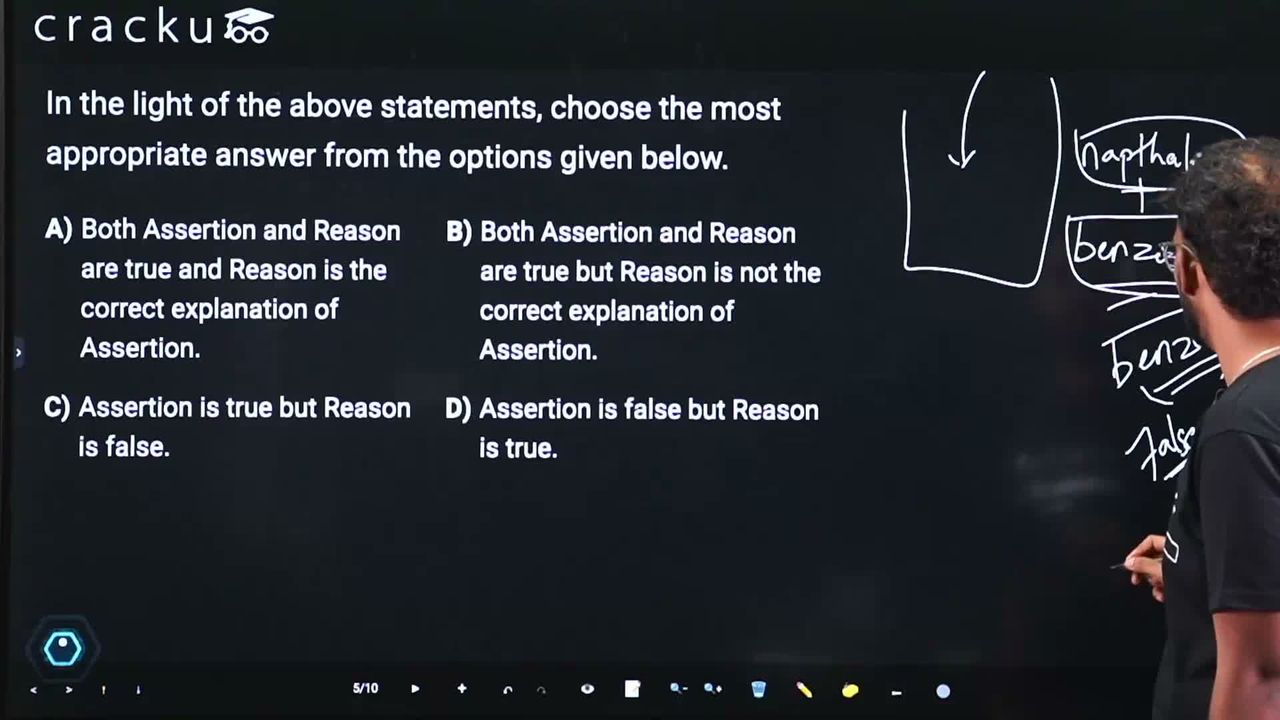
In the light of the above statements, choose the most appropriate answer from the options given below.
Analyzing the Assertion:
"A mixture contains benzoic acid and naphthalene. The pure benzoic acid can be separated out by the use of benzene."
Both benzoic acid and naphthalene are soluble in benzene. So benzene cannot be used to selectively dissolve one and leave the other behind. The standard method to separate benzoic acid from naphthalene would be to use a sodium bicarbonate solution (which dissolves benzoic acid as sodium benzoate, leaving naphthalene behind) or to use hot water (benzoic acid is soluble in hot water, naphthalene is not).
Therefore, the Assertion is false.
Analyzing the Reason:
"Benzoic acid is soluble in hot water."
This is a well-known fact. Benzoic acid has limited solubility in cold water but dissolves readily in hot water. This is the basis for its purification by recrystallization.
Therefore, the Reason is true.
Hence, the correct answer is Option D: Assertion is false but Reason is true.
Was this solution helpful?
Click on the Email ☝️ to Watch the Video Solution
Create a FREE account and get:
_1.webp)

Educational materials for JEE preparation

Ask our AI anything

AI can make mistakes. Please verify important information.
AI can make mistakes. Please verify important information.


