
Join Our JEE Preparation Group
Prep with like-minded aspirants; Get access to free daily tests and study material.
Sign in
Please select an account to continue using cracku.in
↓ →
Join Our JEE Preparation Group
Prep with like-minded aspirants; Get access to free daily tests and study material.
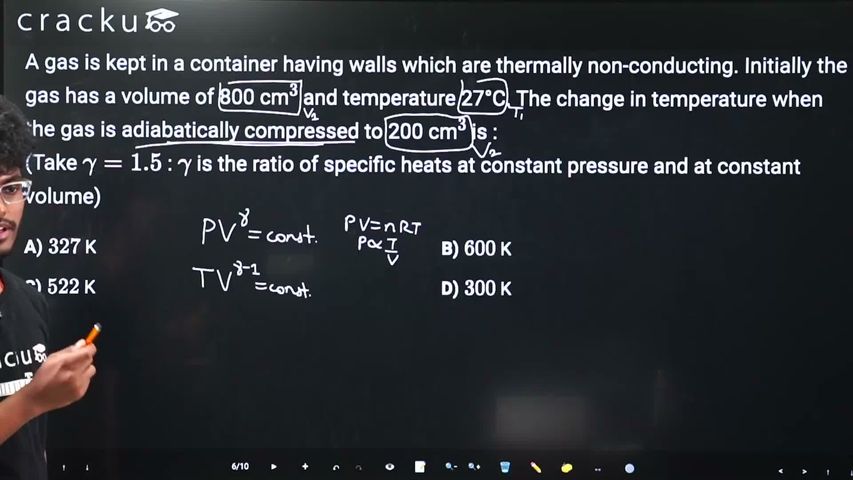
A gas is kept in a container having walls which are thermally non-conducting. Initially the gas has a volume of 800 cm$$^3$$ and temperature 27°C. The change in temperature when the gas is adiabatically compressed to 200 cm$$^3$$ is :
(Take $$\gamma = 1.5$$ : $$\gamma$$ is the ratio of specific heats at constant pressure and at constant volume)
For an adiabatic process involving an ideal gas, the relation between temperature and volume is
$$T\,V^{\gamma-1}= \text{constant}$$
Given data:
Initial volume $$V_1 = 800\;\text{cm}^3$$
Final volume $$V_2 = 200\;\text{cm}^3$$
Initial temperature $$T_1 = 27^\circ\text{C} = 27 + 273 = 300\;\text{K}$$
Specific-heat ratio $$\gamma = 1.5$$
Applying the adiabatic relation for the final temperature $$T_2$$:
$$T_1\,V_1^{\gamma-1}=T_2\,V_2^{\gamma-1}$$
Solve for $$T_2$$:
$$T_2 = T_1\left(\frac{V_1}{V_2}\right)^{\gamma-1}$$
Compute the volume ratio and exponent:
$$\frac{V_1}{V_2} = \frac{800}{200} = 4$$
$$\gamma - 1 = 1.5 - 1 = 0.5$$
Therefore,
$$T_2 = 300\,\text{K}\;\times\;4^{0.5} = 300\,\text{K}\;\times\;2 = 600\,\text{K}$$
The change in temperature is
$$\Delta T = T_2 - T_1 = 600\,\text{K} - 300\,\text{K} = 300\,\text{K}$$
Hence, the temperature rises by $$300\;\text{K}$$.
Option D is correct.
Was this solution helpful?
Click on the Email ☝️ to Watch the Video Solution
Create a FREE account and get:
_1.webp)

Educational materials for JEE preparation

Ask our AI anything

AI can make mistakes. Please verify important information.
AI can make mistakes. Please verify important information.


