Join Our JEE Preparation Group
Prep with like-minded aspirants; Get access to free daily tests and study material.
Sign in
Please select an account to continue using cracku.in
↓ →
Join Our JEE Preparation Group
Prep with like-minded aspirants; Get access to free daily tests and study material.
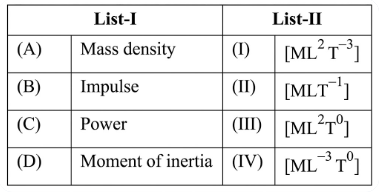
The dimensional formula of a physical quantity is obtained from the defining equation of that quantity in terms of the fundamental mechanical quantities $$M$$ (mass), $$L$$ (length) and $$T$$ (time).
Case (A) : Mass density
Mass density $$\rho$$ is mass per unit volume:
$$\rho = \frac{\text{mass}}{\text{volume}}$$.
Mass has dimension $$[M]$$ and volume has dimension $$[L^3]$$, so
$$[\rho] = \frac{[M]}{[L^3]} = [M L^{-3} T^{0}]$$.
Thus (A) corresponds to (IV).
Case (B) : Impulse
Impulse $$J$$ is defined as force multiplied by the time interval:
$$J = F \, \Delta t$$.
Force has dimension $$[M L T^{-2}]$$ and time has dimension $$[T]$$, so
$$[J] = [M L T^{-2}] \,[T] = [M L T^{-1}]$$.
Thus (B) corresponds to (II).
Case (C) : Power
Power $$P$$ is work done per unit time:
$$P = \frac{W}{t}$$.
Work (or energy) has dimension $$[M L^{2} T^{-2}]$$ and time has dimension $$[T]$$, hence
$$[P] = \frac{[M L^{2} T^{-2}]}{[T]} = [M L^{2} T^{-3}]$$.
Thus (C) corresponds to (I).
Case (D) : Moment of inertia
For a point mass $$m$$ at a distance $$r$$ from the axis, the moment of inertia $$I$$ is:
$$I = m r^{2}$$.
Mass has dimension $$[M]$$ and distance squared has dimension $$[L^{2}]$$, so
$$[I] = [M] [L^{2}] = [M L^{2} T^{0}]$$.
Thus (D) corresponds to (III).
Collecting the matches:
(A) → (IV), (B) → (II), (C) → ( I ), (D) → (III).
This set of matches is given in Option C. Hence the correct answer is Option C.
Was this solution helpful?

Click on the Email ☝️ to Watch the Video Solution
Create a FREE account and get:
_1.webp)

Educational materials for JEE preparation

Ask our AI anything

AI can make mistakes. Please verify important information.
AI can make mistakes. Please verify important information.