
Join Our JEE Preparation Group
Prep with like-minded aspirants; Get access to free daily tests and study material.
Sign in
Please select an account to continue using cracku.in
↓ →
Join Our JEE Preparation Group
Prep with like-minded aspirants; Get access to free daily tests and study material.
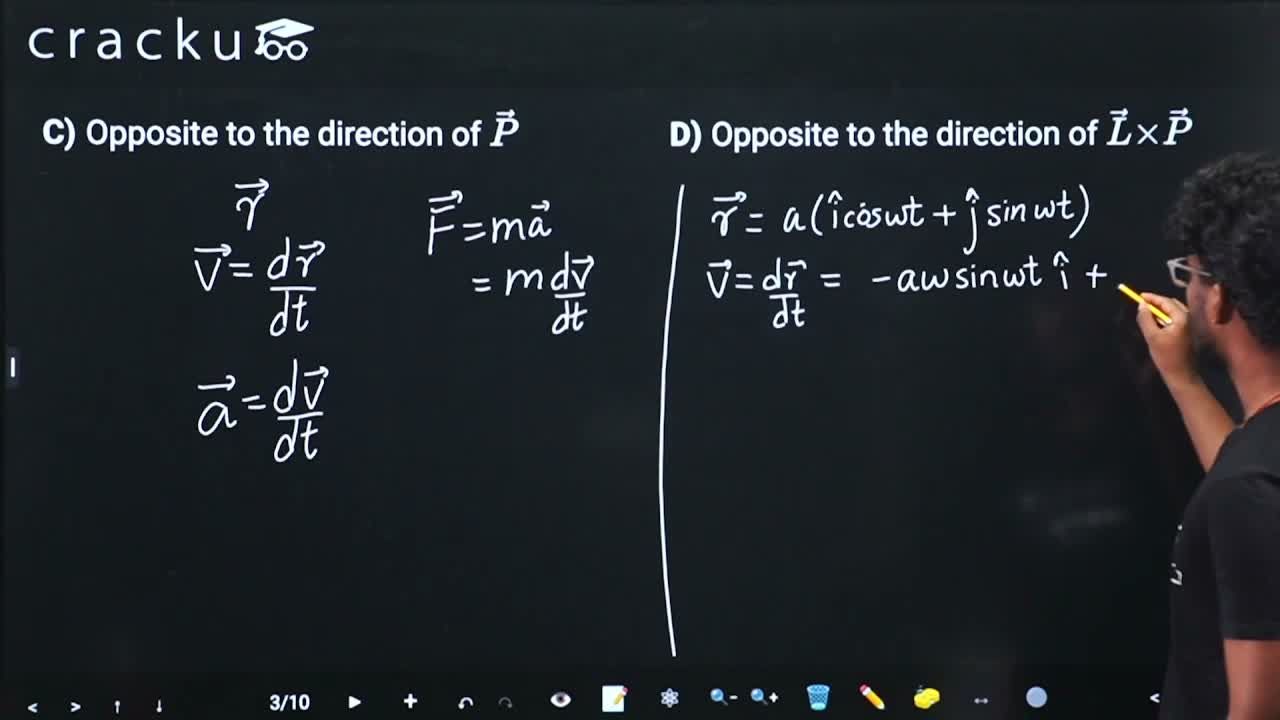
If $$\vec{L}$$ and $$\vec{P}$$ represent the angular momentum and linear momentum respectively of a particle of mass 'm' having position vector $$\vec{r} = a(\hat{i}\cos\omega t + \hat{j}\sin\omega t)$$. The direction of force is
$$\vec{F} = m\vec{a}$$
$$\vec{a} = \frac{d^2\vec{r}}{dt^2}$$
$$\vec{r} = a(\hat{i} \cos \omega t + \hat{j} \sin \omega t)$$
$$\vec{v} = \frac{d\vec{r}}{dt} = a(-\omega \hat{i} \sin \omega t + \omega \hat{j} \cos \omega t)$$
$$\vec{v} = a\omega(-\hat{i} \sin \omega t + \hat{j} \cos \omega t)$$
$$\vec{a} = \frac{d\vec{v}}{dt} = a\omega(-\omega \hat{i} \cos \omega t - \omega \hat{j} \sin \omega t)$$
$$\vec{a} = -\omega^2 \cdot a(\hat{i} \cos \omega t + \hat{j} \sin \omega t)$$
$$\vec{a} = -\omega^2 \vec{r}$$
$$\vec{F} = m\vec{a} = -m\omega^2 \vec{r}$$
Since mass ($$m$$) and squared angular frequency ($$\omega^2$$) are strictly positive scalar quantities, the negative sign indicates that the force vector $$\vec{F}$$ points directly in the direction opposite to the position vector $$\vec{r}$$.
Was this solution helpful?
Click on the Email ☝️ to Watch the Video Solution
Create a FREE account and get:
_1.webp)

Educational materials for JEE preparation

Ask our AI anything

AI can make mistakes. Please verify important information.
AI can make mistakes. Please verify important information.
