
Join Our JEE Preparation Group
Prep with like-minded aspirants; Get access to free daily tests and study material.
Sign in
Please select an account to continue using cracku.in
↓ →
Join Our JEE Preparation Group
Prep with like-minded aspirants; Get access to free daily tests and study material.
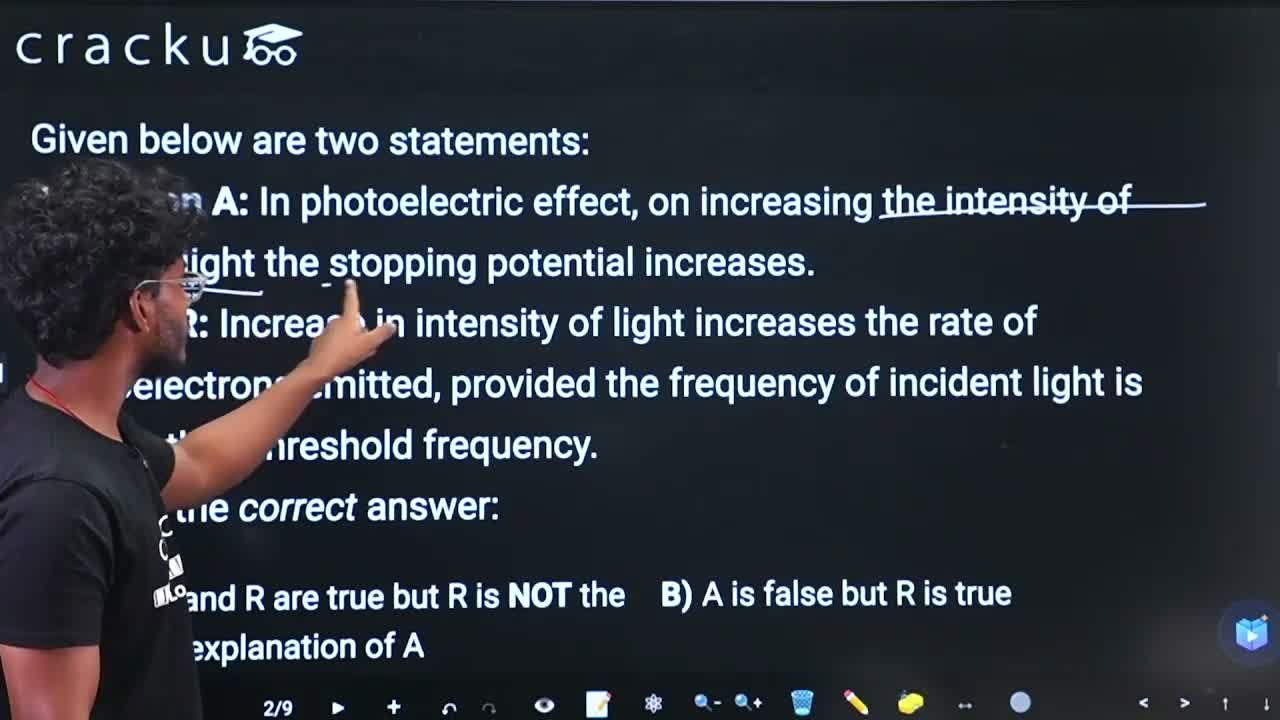
Given below are two statements:
Assertion A: In photoelectric effect, on increasing the intensity of incident light the stopping potential increases.
Reason R: Increase in intensity of light increases the rate of photoelectrons emitted, provided the frequency of incident light is greater than threshold frequency.
Choose the correct answer:
The photoelectric equation is $$eV_0 = h\nu - \phi$$, where $$V_0$$ is the stopping potential, $$\nu$$ is the frequency of incident light and $$\phi$$ is the work function of the metal.
From the above relation we see that $$V_0$$ depends only on the frequency $$\nu$$ (and the work function $$\phi$$), not on the intensity of light. Therefore, even if the intensity is increased, the stopping potential remains unchanged. Hence Assertion A is false.
Intensity of light represents the number of photons incident per unit time. When the frequency $$\nu$$ is kept greater than the threshold frequency $$\nu_0$$ so that each photon has energy $$h\nu \gt \phi$$, an increase in the number of photons results in a proportional increase in the number of emitted photoelectrons. Thus the emission rate (photoelectric current for a given potential) increases. Reason R is therefore true.
We conclude: Assertion A is false but Reason R is true. This corresponds to Option B.
Was this solution helpful?
Click on the Email ☝️ to Watch the Video Solution
Create a FREE account and get:
_1.webp)

Educational materials for JEE preparation

Ask our AI anything

AI can make mistakes. Please verify important information.
AI can make mistakes. Please verify important information.
