
Join Our JEE Preparation Group
Prep with like-minded aspirants; Get access to free daily tests and study material.
Sign in
Please select an account to continue using cracku.in
↓ →
Join Our JEE Preparation Group
Prep with like-minded aspirants; Get access to free daily tests and study material.
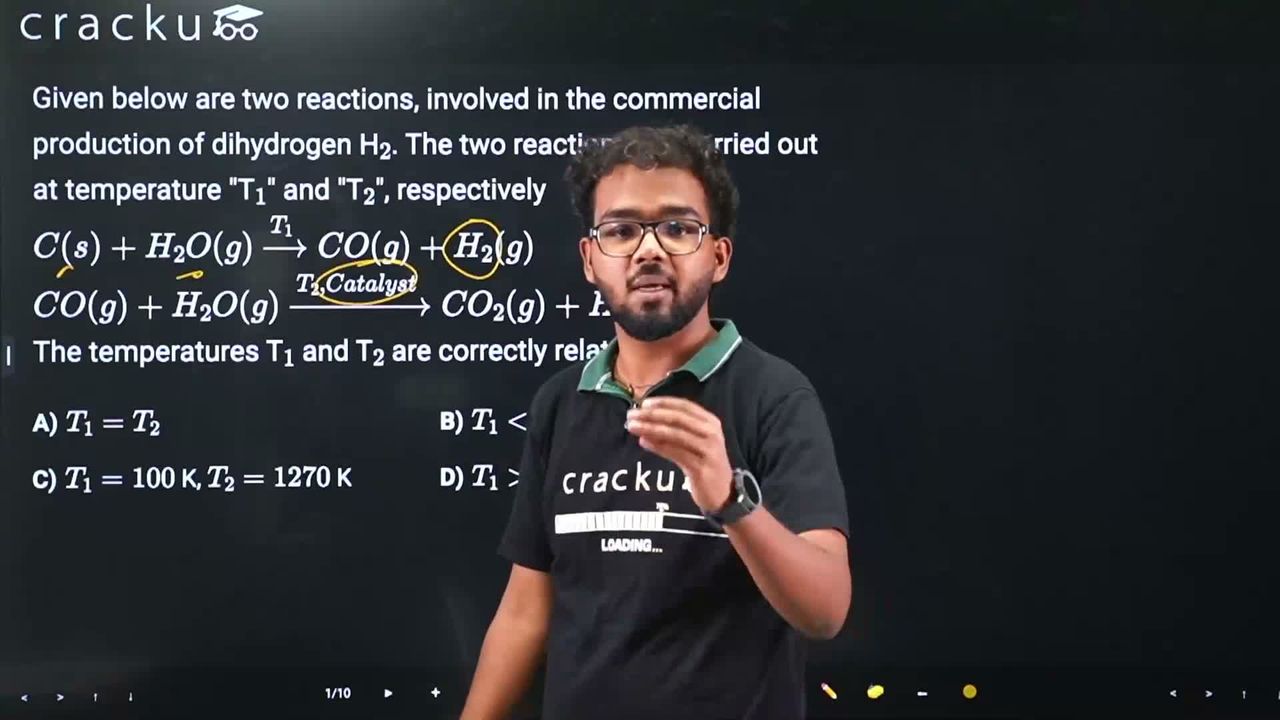
Given below are two reactions, involved in the commercial production of dihydrogen H$$_2$$. The two reactions are carried out at temperature "T$$_1$$" and "T$$_2$$", respectively
$$C(s) + H_2O(g) \xrightarrow{T_1} CO(g) + H_2(g)$$
$$CO(g) + H_2O(g) \xrightarrow{T_2, Catalyst} CO_2(g) + H_2(g)$$
The temperatures T$$_1$$ and T$$_2$$ are correctly related as
We need to compare the temperatures $$T_1$$ and $$T_2$$ for two reactions in commercial H$$_2$$ production.
Reaction 1 (Water-gas reaction).
$$ C(s) + H_2O(g) \xrightarrow{T_1} CO(g) + H_2(g) $$
This is a highly endothermic reaction ($$\Delta H \approx +131$$ kJ/mol). It requires breaking the strong O-H bond in water and the C-C bonds in solid carbon. This reaction requires a very high temperature, typically around $$T_1 \approx 1270$$ K (about 1000 degrees C), to proceed at an appreciable rate.
Reaction 2 (Water-gas shift reaction).
$$ CO(g) + H_2O(g) \xrightarrow{T_2, \text{catalyst}} CO_2(g) + H_2(g) $$
This is a mildly exothermic reaction ($$\Delta H \approx -41$$ kJ/mol). It is carried out at a much lower temperature, typically $$T_2 \approx 673$$ K (about 400 degrees C), using an iron-chromate catalyst. The catalyst lowers the activation energy, allowing the reaction to proceed efficiently at this lower temperature.
Comparison:
$$ T_1 (\sim 1270\;\text{K}) > T_2 (\sim 673\;\text{K}) $$
The correct answer is Option 4: $$T_1 > T_2$$.
Was this solution helpful?
Click on the Email ☝️ to Watch the Video Solution
Create a FREE account and get:
_1.webp)

Educational materials for JEE preparation

Ask our AI anything

AI can make mistakes. Please verify important information.
AI can make mistakes. Please verify important information.
