
Join Our JEE Preparation Group
Prep with like-minded aspirants; Get access to free daily tests and study material.
Sign in
Please select an account to continue using cracku.in
↓ →
Join Our JEE Preparation Group
Prep with like-minded aspirants; Get access to free daily tests and study material.
At room temperature, disproportionation of an aqueous solution of in situ generated nitrous acid ($$HNO_2$$) gives the species
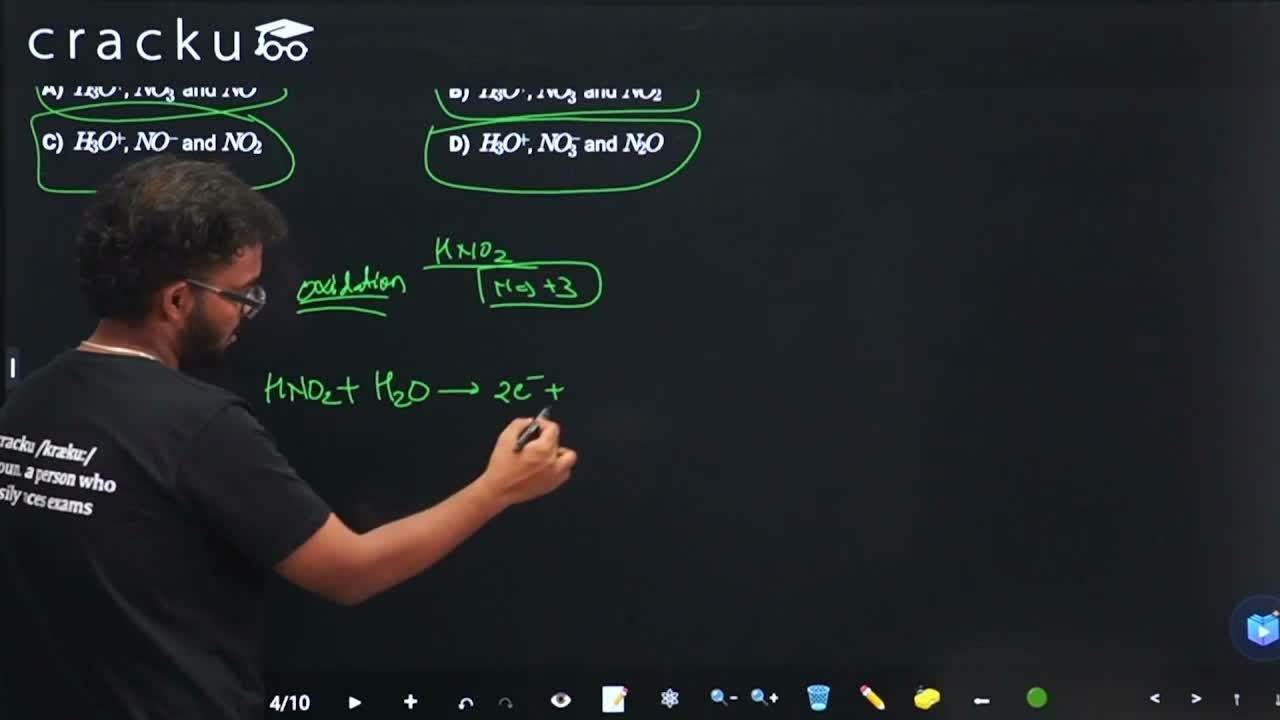
Nitrous acid, $$HNO_2$$, is an unstable, weak, monobasic acid in which nitrogen has the oxidation state $$+3$$.
In aqueous medium at room temperature it undergoes disproportionation (simultaneous oxidation and reduction of the same species).
To find the products, we balance two half-reactions for nitrogen:
Oxidation half-reaction (N : $$+3 \rightarrow +5$$)
$$HNO_2 + H_2O \rightarrow NO_3^- + 3\,H^+ + 2\,e^-$$
Reduction half-reaction (N : $$+3 \rightarrow +2$$)
$$HNO_2 + e^- \rightarrow NO + H_2O$$
Multiply the reduction half-reaction by $$2$$ so that the electron numbers match, then add:
$$\bigl(HNO_2 + H_2O \rightarrow NO_3^- + 3\,H^+ + 2\,e^- \bigr)$$
$$+$$
$$\bigl(2\,HNO_2 + 2\,e^- \rightarrow 2\,NO + 2\,H_2O \bigr)$$
After canceling the $$2\,e^-$$ on both sides and combining water molecules, we obtain
$$3\,HNO_2 \rightarrow NO_3^- + 2\,NO + H_2O + 3\,H^+$$
In water each $$H^+$$ immediately forms $$H_3O^+$$, so the observable species in the solution (and gas phase) are
$$H_3O^+,\; NO_3^- \text{ and } NO(g)$$
Thus the disproportionation of in-situ generated $$HNO_2$$ at room temperature gives Option A.
Answer - Option A: $$H_3O^+$$, $$NO_3^-$$ and $$NO$$
Was this solution helpful?
Click on the Email ☝️ to Watch the Video Solution
Create a FREE account and get:
_1.webp)

Educational materials for JEE preparation

Ask our AI anything

AI can make mistakes. Please verify important information.
AI can make mistakes. Please verify important information.
