
Join Our JEE Preparation Group
Prep with like-minded aspirants; Get access to free daily tests and study material.
Sign in
Please select an account to continue using cracku.in
↓ →
Join Our JEE Preparation Group
Prep with like-minded aspirants; Get access to free daily tests and study material.
First, recall Kohlrausch’s Law of Independent Migration of Ions, which states
$$\Lambda_m^0(\text{electrolyte}) = \lambda^0_+ + \lambda^0_-$$
where $$\lambda^0_+$$ is the limiting molar ionic conductivity of the cation and $$\lambda^0_-$$ is that of the anion. With this law we can expand every limiting molar conductivity appearing in the options into the sum of its two ionic parts and then compare both sides algebraically, term by term.
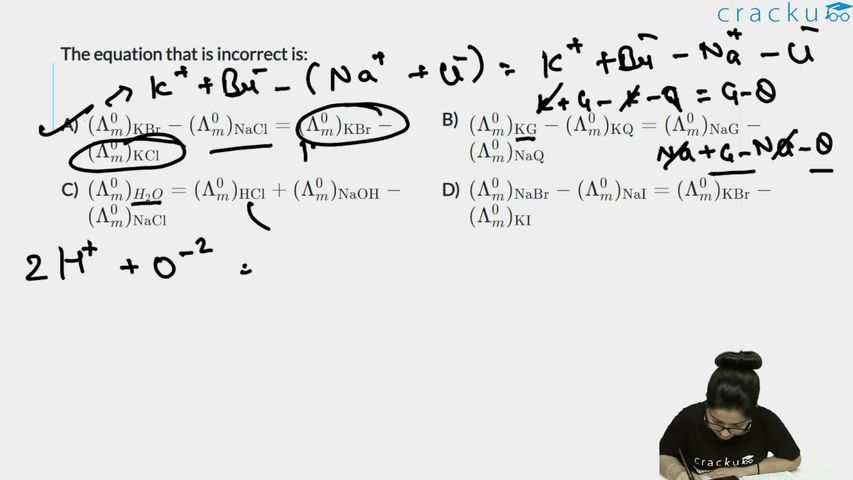
Option A proposes
$$ (\Lambda_m^0)_{\text{KBr}} - (\Lambda_m^0)_{\text{NaCl}} \;=\; (\Lambda_m^0)_{\text{KBr}} - (\Lambda_m^0)_{\text{KCl}} $$
Using Kohlrausch’s law on each symbol:
$$$ \begin{aligned} (\Lambda_m^0)_{\text{KBr}} &= \lambda_{\text{K}}^0 + \lambda_{\text{Br}}^0,\\ (\Lambda_m^0)_{\text{NaCl}} &= \lambda_{\text{Na}}^0 + \lambda_{\text{Cl}}^0,\\ (\Lambda_m^0)_{\text{KCl}} &= \lambda_{\text{K}}^0 + \lambda_{\text{Cl}}^0. \end{aligned} $$$
Now substitute:
$$$ \begin{aligned} \text{LHS} &= (\lambda_{\text{K}}^0 + \lambda_{\text{Br}}^0) - (\lambda_{\text{Na}}^0 + \lambda_{\text{Cl}}^0)\\[4pt] &= \lambda_{\text{K}}^0 - \lambda_{\text{Na}}^0 + \lambda_{\text{Br}}^0 - \lambda_{\text{Cl}}^0, \end{aligned} $$$
$$$ \begin{aligned} \text{RHS} &= (\lambda_{\text{K}}^0 + \lambda_{\text{Br}}^0) - (\lambda_{\text{K}}^0 + \lambda_{\text{Cl}}^0)\\[4pt] &= \lambda_{\text{Br}}^0 - \lambda_{\text{Cl}}^0. \end{aligned} $$$
The two sides will be equal only if $$\lambda_{\text{K}}^0 - \lambda_{\text{Na}}^0 = 0,$$ i.e. $$\lambda_{\text{K}}^0 = \lambda_{\text{Na}}^0,$$ which is not true experimentally. Therefore option A is incorrect.
Option B states
$$ (\Lambda_m^0)_{\text{KG}} - (\Lambda_m^0)_{\text{KQ}} \;=\; (\Lambda_m^0)_{\text{NaG}} - (\Lambda_m^0)_{\text{NaQ}}. $$
Expanding each term (with G and Q as arbitrary anions):
$$$ \begin{aligned} \text{LHS} &= (\lambda_{\text{K}}^0 + \lambda_{\text{G}}^0) - (\lambda_{\text{K}}^0 + \lambda_{\text{Q}}^0)\\[4pt] &= \lambda_{\text{G}}^0 - \lambda_{\text{Q}}^0,\\[8pt] \text{RHS} &= (\lambda_{\text{Na}}^0 + \lambda_{\text{G}}^0) - (\lambda_{\text{Na}}^0 + \lambda_{\text{Q}}^0)\\[4pt] &= \lambda_{\text{G}}^0 - \lambda_{\text{Q}}^0. \end{aligned} $$$
Both sides are identical, hence option B is correct.
Option C claims
$$ (\Lambda_m^0)_{H_2O} \;=\; (\Lambda_m^0)_{\text{HCl}} + (\Lambda_m^0)_{\text{NaOH}} - (\Lambda_m^0)_{\text{NaCl}}. $$
Writing each conductivity in ionic form:
$$$ \begin{aligned} (\Lambda_m^0)_{H_2O} &= \lambda_{\text{H}}^0 + \lambda_{\text{OH}}^0,\\ (\Lambda_m^0)_{\text{HCl}} &= \lambda_{\text{H}}^0 + \lambda_{\text{Cl}}^0,\\ (\Lambda_m^0)_{\text{NaOH}} &= \lambda_{\text{Na}}^0 + \lambda_{\text{OH}}^0,\\ (\Lambda_m^0)_{\text{NaCl}} &= \lambda_{\text{Na}}^0 + \lambda_{\text{Cl}}^0. \end{aligned} $$$
Substituting into the RHS:
$$$ \begin{aligned} \text{RHS} &= (\lambda_{\text{H}}^0 + \lambda_{\text{Cl}}^0) + (\lambda_{\text{Na}}^0 + \lambda_{\text{OH}}^0) - (\lambda_{\text{Na}}^0 + \lambda_{\text{Cl}}^0)\\[4pt] &= \lambda_{\text{H}}^0 + \lambda_{\text{OH}}^0, \end{aligned} $$$
which matches the LHS exactly. Therefore option C is correct.
Option D proposes
$$ (\Lambda_m^0)_{\text{NaBr}} - (\Lambda_m^0)_{\text{NaI}} \;=\; (\Lambda_m^0)_{\text{KBr}} - (\Lambda_m^0)_{\text{KI}}. $$
Again convert to ionic contributions:
$$$ \begin{aligned} \text{LHS} &= (\lambda_{\text{Na}}^0 + \lambda_{\text{Br}}^0) - (\lambda_{\text{Na}}^0 + \lambda_{\text{I}}^0)\\[4pt] &= \lambda_{\text{Br}}^0 - \lambda_{\text{I}}^0,\\[8pt] \text{RHS} &= (\lambda_{\text{K}}^0 + \lambda_{\text{Br}}^0) - (\lambda_{\text{K}}^0 + \lambda_{\text{I}}^0)\\[4pt] &= \lambda_{\text{Br}}^0 - \lambda_{\text{I}}^0. \end{aligned} $$$
Both sides coincide, so option D is correct.
From these detailed algebraic checks we see that only option A fails the equality test.
Hence, the answer is Option A.
Was this solution helpful?
Click on the Email ☝️ to Watch the Video Solution
Create a FREE account and get:
_1.webp)

Educational materials for JEE preparation

Ask our AI anything

AI can make mistakes. Please verify important information.
AI can make mistakes. Please verify important information.
