
Join Our JEE Preparation Group
Prep with like-minded aspirants; Get access to free daily tests and study material.
Sign in
Please select an account to continue using cracku.in
↓ →
Join Our JEE Preparation Group
Prep with like-minded aspirants; Get access to free daily tests and study material.
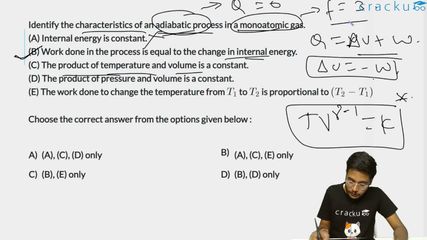
Identify the characteristics of an adiabatic process in a monoatomic gas.
(A) Internal energy is constant.
(B) Work done in the process is equal to the change in internal energy.
(C) The product of temperature and volume is a constant.
(D) The product of pressure and volume is a constant.
(E) The work done to change the temperature from $$T_1$$ to $$T_2$$ is proportional to $$(T_2 - T_1)$$
Choose the correct answer from the options given below :
For an adiabatic process of an ideal gas, the heat exchanged with the surroundings is zero: $$Q = 0$$.
First law of thermodynamics: $$\Delta U = Q + W$$, where $$W$$ is the work done on the gas.
Because $$Q = 0$$, we have
$$\Delta U = W \quad -(1)$$
For a monoatomic ideal gas, the internal energy is $$U = \dfrac{3}{2}nRT$$. Hence
$$\Delta U = \dfrac{3}{2}nR\,(T_2 - T_1) \quad -(2)$$
Using $$(1)$$ and $$(2)$$, the work done on the gas is
$$W = \dfrac{3}{2}nR\,(T_2 - T_1) \quad -(3)$$
Thus, $$W$$ is directly proportional to $$(T_2 - T_1)$$.
For an adiabatic change of an ideal gas, the pressure-volume relation is $$PV^{\gamma} = \text{constant}$$, where $$\gamma = \dfrac{C_P}{C_V}$$. For a monoatomic gas, $$\gamma = \dfrac{5}{3}$$. Consequently
$$TV^{\gamma - 1} = TV^{2/3} = \text{constant}$$,
which is not simply $$TV = \text{constant}$$, and $$PV$$ is also not constant.
Now examine each statement:
Statement (A): “Internal energy is constant.”
From $$(2)$$, $$\Delta U \neq 0$$ when temperature changes, so (A) is false.
Statement (B): “Work done in the process is equal to the change in internal energy.”
Equation $$(1)$$ shows $$W = \Delta U$$ (with the ‘work on the gas’ sign convention). Hence (B) is true.
Statement (C): “The product of temperature and volume is a constant.”
We have $$TV^{2/3} = \text{constant}$$, not $$TV$$. Therefore (C) is false.
Statement (D): “The product of pressure and volume is a constant.”
For adiabatic change, $$PV^{5/3} = \text{constant}$$, so $$PV$$ is not constant. (D) is false.
Statement (E): “The work done to change the temperature from $$T_1$$ to $$T_2$$ is proportional to $$(T_2 - T_1)$$.”
Equation $$(3)$$ confirms this proportionality. Hence (E) is true.
Therefore, only statements (B) and (E) are correct.
Option C (B, E only) is the correct choice.
Was this solution helpful?
Click on the Email ☝️ to Watch the Video Solution
Create a FREE account and get:
_1.webp)

Educational materials for JEE preparation

Ask our AI anything

AI can make mistakes. Please verify important information.
AI can make mistakes. Please verify important information.


