
Join Our JEE Preparation Group
Prep with like-minded aspirants; Get access to free daily tests and study material.
Sign in
Please select an account to continue using cracku.in
↓ →
Join Our JEE Preparation Group
Prep with like-minded aspirants; Get access to free daily tests and study material.
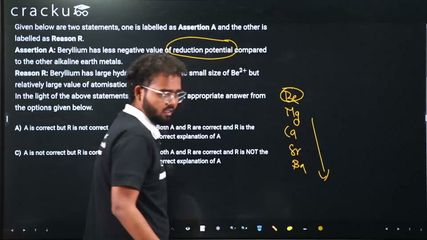
Given below are two statements, one is labelled as Assertion A and the other is labelled as Reason R.
Assertion A: Beryllium has less negative value of reduction potential compared to the other alkaline earth metals.
Reason R: Beryllium has large hydration energy due to small size of Be$$^{2+}$$ but relatively large value of atomisation enthalpy.
In the light of the above statements, choose the most appropriate answer from the options given below.
Assertion (A) is correct.
The standard reduction potential of beryllium is less negative than that of the other alkaline earth metals.
$$E^\circ(\mathrm{Be^{2+}/Be})=-1.97\ \mathrm{V}$$
whereas for the heavier Group 2 metals the values are more negative.
The reduction potential depends on the balance of atomisation enthalpy, ionisation enthalpy and hydration enthalpy involved in the process
$$M_{(s)} \rightarrow M^{2+}_{(aq)} + 2e^-$$
For beryllium,
- Atomisation enthalpy is very high because of its strong metallic bonding.
- First and second ionisation enthalpies are exceptionally high due to its small atomic size.
- Hydration enthalpy of $$\mathrm{Be^{2+}}$$ is also very large because of its high charge density.
Although hydration releases a large amount of energy, it does not completely compensate for the very high atomisation and ionisation enthalpies.
As a result, beryllium has a lower tendency to oxidise than the other alkaline earth metals, leading to a less negative standard reduction potential.
Hence, Reason (R) is also correct and it correctly explains Assertion (A).
Therefore,
$$\boxed{\text{Both A and R are true, and R is the correct explanation of A}}$$
Was this solution helpful?
Click on the Email ☝️ to Watch the Video Solution
Create a FREE account and get:
_1.webp)

Educational materials for JEE preparation

Ask our AI anything

AI can make mistakes. Please verify important information.
AI can make mistakes. Please verify important information.
