
Join Our JEE Preparation Group
Prep with like-minded aspirants; Get access to free daily tests and study material.
Sign in
Please select an account to continue using cracku.in
↓ →
Join Our JEE Preparation Group
Prep with like-minded aspirants; Get access to free daily tests and study material.
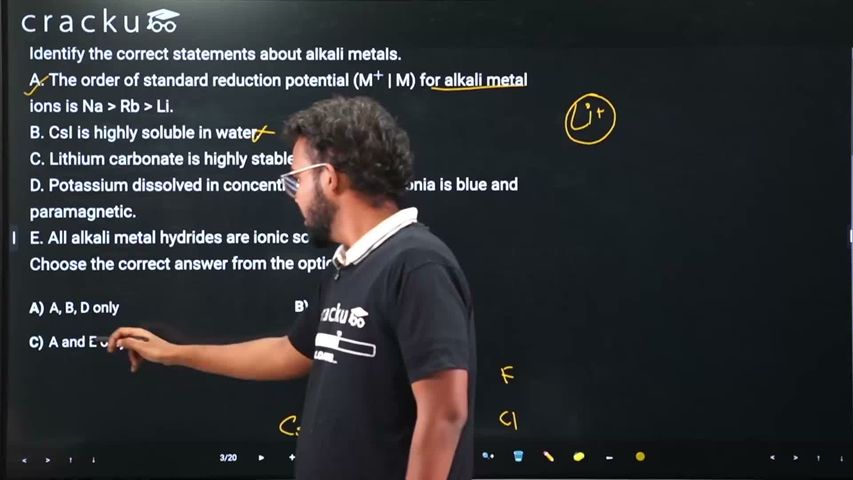
Identify the correct statements about alkali metals.
A. The order of standard reduction potential (M$$^+$$ | M) for alkali metal ions is Na > Rb > Li.
B. CsI is highly soluble in water.
C. Lithium carbonate is highly stable to heat.
D. Potassium dissolved in concentrated liquid ammonia is blue and paramagnetic.
E. All alkali metal hydrides are ionic solids.
Choose the correct answer from the options given below
We need to identify the correct statements about alkali metals.
Statement A: The order of standard reduction potential (M$$^+$$|M) for alkali metal ions is Na > Rb > Li. The standard reduction potentials are approximately: Li at $$-3.04$$ V, Na at $$-2.71$$ V, K at $$-2.93$$ V, Rb at $$-2.98$$ V, and Cs at $$-3.03$$ V. Although Li has the highest ionization energy, its exceptionally high hydration energy (due to the very small Li$$^+$$ ionic radius) makes its reduction potential the most negative. The order Na ($$-2.71$$) > Rb ($$-2.98$$) > Li ($$-3.04$$) is correct.
Statement B: CsI is claimed to be highly soluble in water. CsI consists of two large ions with low lattice energy but also low hydration energies. In the context of JEE, this claim is not considered a standard correct statement. This is incorrect.
Statement C: Lithium carbonate is claimed to be highly stable to heat. However, Li$$_2$$CO$$_3$$ decomposes on heating:
$$\text{Li}_2\text{CO}_3 \xrightarrow{\Delta} \text{Li}_2\text{O} + \text{CO}_2$$
The small, highly charged Li$$^+$$ cation strongly polarizes the large carbonate ion, destabilizing it. So Li$$_2$$CO$$_3$$ is the least stable alkali metal carbonate to heat. This is incorrect.
Statement D: Potassium dissolved in concentrated liquid ammonia is claimed to be blue and paramagnetic. However, dilute solutions of alkali metals in ammonia are blue and paramagnetic, while concentrated solutions are bronze and diamagnetic due to pairing of solvated electrons. This is incorrect.
Statement E: All alkali metal hydrides are ionic solids. Indeed, all alkali metals form ionic hydrides MH with M$$^+$$ cations and H$$^-$$ anions, adopting the NaCl-type crystal structure. This is correct.
The correct statements are A and E only. Hence, the correct answer is Option 3.
Was this solution helpful?
Click on the Email ☝️ to Watch the Video Solution
Create a FREE account and get:
_1.webp)

Educational materials for JEE preparation

Ask our AI anything

AI can make mistakes. Please verify important information.
AI can make mistakes. Please verify important information.
