
Join Our JEE Preparation Group
Prep with like-minded aspirants; Get access to free daily tests and study material.
Sign in
Please select an account to continue using cracku.in
↓ →
Join Our JEE Preparation Group
Prep with like-minded aspirants; Get access to free daily tests and study material.
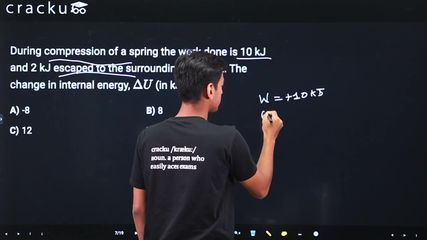
During compression of a spring the work done is 10 kJ and 2 kJ escaped to the surroundings as heat. The change in internal energy, $$\Delta U$$ (in kJ) is:
First of all, we recall the First Law of Thermodynamics, which states that for any process,
$$\Delta U = Q + W$$
Here,
• $$\Delta U$$ is the change in internal energy of the system.
• $$Q$$ is the heat supplied to the system (positive when the system receives heat, negative when it loses heat).
• $$W$$ is the work done on the system (positive when work is done on the system, negative when the system does work on the surroundings).
Now, according to the question, a spring is being compressed. During this compression:
1. The work done on the spring is given as 10 kJ. Because the surroundings are doing work on the system (the spring), we treat this as positive work. Mathematically,
$$W = +10 \text{ kJ}$$
2. Out of this energy, 2 kJ is lost from the system to the surroundings in the form of heat. Since the system is losing heat, heat flow is taken as negative. Hence,
$$Q = -2 \text{ kJ}$$
With both $$Q$$ and $$W$$ identified and signs assigned according to the convention, we substitute these values into the First Law expression:
$$\Delta U = Q + W$$
Substituting, we get
$$\Delta U = (-2 \text{ kJ}) + (10 \text{ kJ})$$
Combining the numerical values step by step,
$$\Delta U = -2 + 10$$
$$\Delta U = 8 \text{ kJ}$$
Thus, the internal energy of the spring increases by 8 kJ.
Hence, the correct answer is Option B.
Was this solution helpful?
Click on the Email ☝️ to Watch the Video Solution
Create a FREE account and get:
_1.webp)

Educational materials for JEE preparation

Ask our AI anything

AI can make mistakes. Please verify important information.
AI can make mistakes. Please verify important information.


