
Join Our JEE Preparation Group
Prep with like-minded aspirants; Get access to free daily tests and study material.
Sign in
Please select an account to continue using cracku.in
↓ →
Join Our JEE Preparation Group
Prep with like-minded aspirants; Get access to free daily tests and study material.
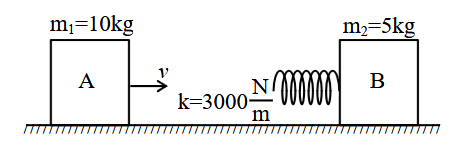
Consider two blocks A and B of masses $$m_1 = 10$$ kg and $$m_2 = 5$$ kg that are placed on a frictionless table. The block A moves with a constant speed $$v = 3$$ m/s towards the block B kept at rest. A spring with spring constant $$k = 3000$$ N/m is attached with the block B as shown in the figure. After the collision, suppose that the blocks A and B, along with the spring in constant compression state, move together, then the compression in the spring is, (Neglect the mass of the spring)
First step is to find out $$v_f$$ which is the final velocity with which both the blocks along with the spring move
Using conservation of momentum:-
so $$m_1v_1=\left(m_1+m_2\right)v_f$$
$$v_f=\frac{m_1v_1}{m_1+m_2}$$
On substituting the given values
$$v_f=\frac{10\times\ 3}{10+5}$$
$$v_f=\frac{30}{15}=2\ \frac{m}{s}$$
Now lets conserve Energy
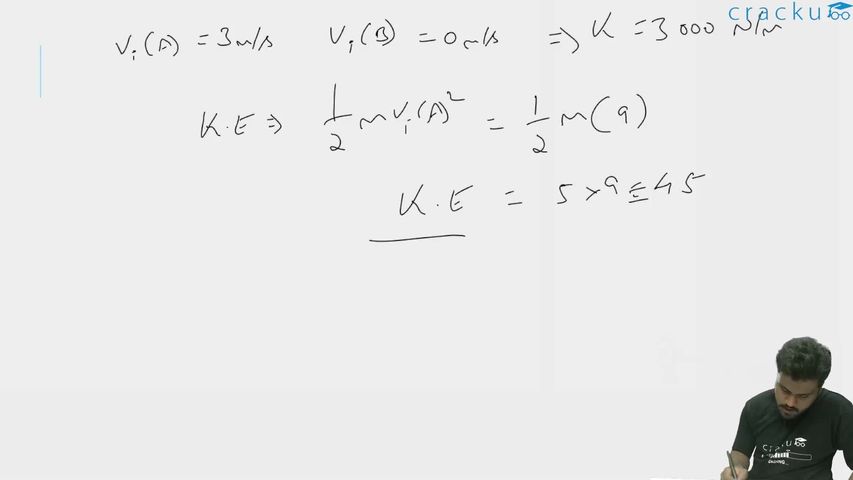
Initital K.E = $$\frac{1}{2}m_1v_1^2$$
$$=\frac{1}{2}\times\ 10\times\left(\ 3^2\right)$$
$$=5\times9$$
$$K.E_i=45$$
Final K.E is $$\frac{1}{2}\left(m_1+m_2\right)v_f^2$$
$$=\frac{1}{2}\left(10+5\right)\times\ 2^2$$
$$=15\times\ 2$$
$$K.E_f=30$$
Now difference between these is the energy stored in the spring
$$K.E_i-K.E_f$$$$K.E_i-K.E_f\ =\ \ 45-\ 30\ =15$$
Now
$$\frac{1}{2}kx^2=15$$
$$\frac{1}{2}\times\ 3000\times\ x^2=15$$
$$\ x^2=\frac{30}{3000}$$
$$\ x^2=\frac{1}{100}=10^{-2}$$
$$\ x=10^{-1}=0.1m$$
Click on the Email ☝️ to Watch the Video Solution
Create a FREE account and get:
_1.webp)

Educational materials for JEE preparation

Ask our AI anything

AI can make mistakes. Please verify important information.
AI can make mistakes. Please verify important information.


