
Join Our JEE Preparation Group
Prep with like-minded aspirants; Get access to free daily tests and study material.
Sign in
Please select an account to continue using cracku.in
↓ →
Join Our JEE Preparation Group
Prep with like-minded aspirants; Get access to free daily tests and study material.
For elements B, C, N, Li, Be, O and F, the correct order of first ionisation enthalpy is
Ionisation enthalpy (IE) is the energy required to remove the most loosely bound electron from a gaseous atom.
General periodic trend: Across a period (left → right) the nuclear charge increases while the principal quantum number remains the same, so atomic size decreases and the IE normally increases.
However, two well-known deviations appear in every short period:
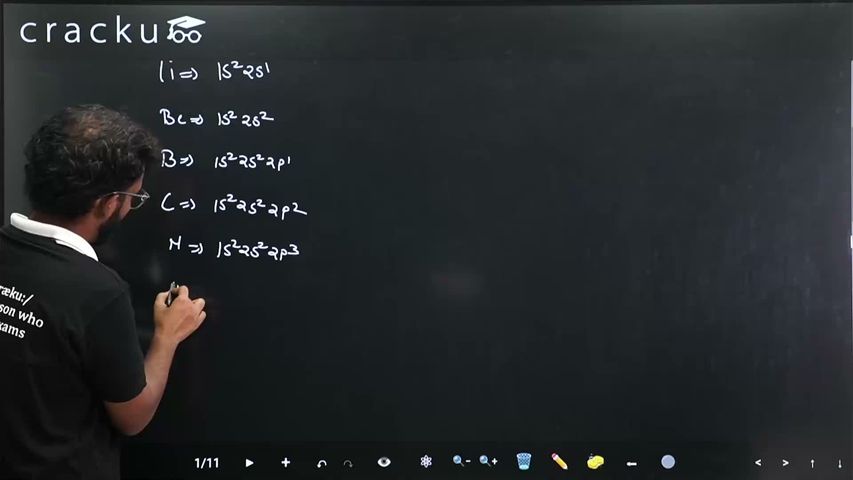
Case 1: Be vs B - Be has the configuration $$1s^22s^2$$ (completely filled $$2s$$ subshell) while B is $$1s^22s^22p^1$$. A completely filled subshell is extra-stable, so more energy is required to remove an electron from Be than from B. Therefore $$\text{IE(Be)} \gt \text{IE(B)}$$, opposite to the simple left→right trend.
Case 2: N vs O - N is $$1s^22s^22p^3$$ (exactly half-filled $$2p$$ subshell); O is $$1s^22s^22p^4$$. The half-filled $$2p$$ subshell of N is more stable than the partly filled subshell of O, so $$\text{IE(N)} \gt \text{IE(O)}$$, again reversing the straightforward trend.
Placing the seven given elements in Period 2 and applying these two exceptions:
1. Start at the far left: $$\text{IE(Li)}$$ is the least.
2. Between B and Be, the exception “Be > B” applies, so $$\text{IE(B)} \lt \text{IE(Be)}$$.
3. C follows the normal order, coming after Be.
4. Between N and O, the exception “N > O” applies, so $$\text{IE(O)} \lt \text{IE(N)}$$.
5. F, at the extreme right, has the maximum IE in the period.
Arranging from the smallest to the largest ionisation enthalpy:
$$\text{Li} \lt \text{B} \lt \text{Be} \lt \text{C} \lt \text{O} \lt \text{N} \lt \text{F}$$
This matches Option D.
Answer: Option D
Was this solution helpful?
Click on the Email ☝️ to Watch the Video Solution
Create a FREE account and get:
_1.webp)

Educational materials for JEE preparation

Ask our AI anything

AI can make mistakes. Please verify important information.
AI can make mistakes. Please verify important information.
