
Join Our JEE Preparation Group
Prep with like-minded aspirants; Get access to free daily tests and study material.
Sign in
Please select an account to continue using cracku.in
↓ →
Join Our JEE Preparation Group
Prep with like-minded aspirants; Get access to free daily tests and study material.
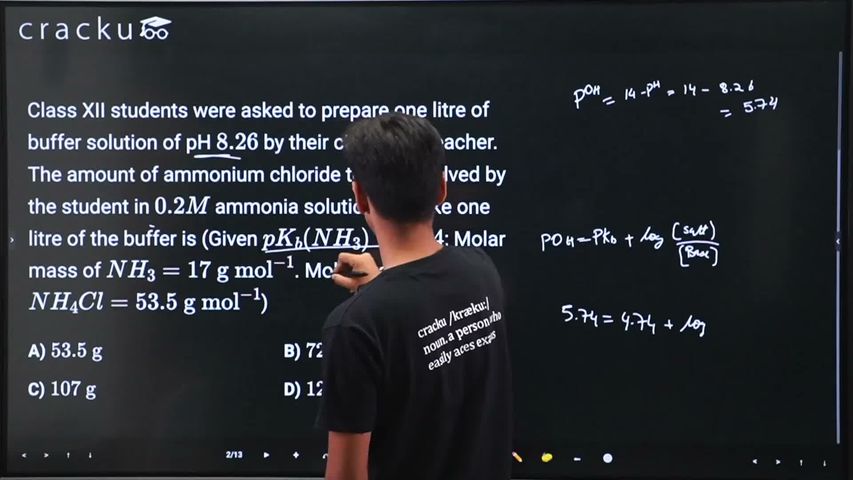
Class XII students were asked to prepare one litre of buffer solution of pH $$8.26$$ by their chemistry teacher. The amount of ammonium chloride to be dissolved by the student in $$0.2M$$ ammonia solution to make one litre of the buffer is (Given $$pK_b(NH_3) = 4.74$$; Molar mass of $$NH_3 = 17 \text{ g mol}^{-1}$$. Molar mass of $$NH_4Cl = 53.5 \text{ g mol}^{-1}$$)
We have a buffer solution of pH = 8.26 prepared from ammonia of concentration 0.2 M, given that $$pK_b(NH_3) = 4.74$$ and the molar mass of $$NH_4Cl$$ is $$53.5\text{ g/mol}$$.
Since $$pOH = 14 - pH$$, we find $$pOH = 14 - 8.26 = 5.74$$.
Applying the Henderson‐Hasselbalch equation for a basic buffer, $$pOH = pK_b + \log\frac{[\text{salt}]}{[\text{base}]}$$, gives $$5.74 = 4.74 + \log\frac{[NH_4Cl]}{0.2}$$.
Solving for the ratio yields $$\log\frac{[NH_4Cl]}{0.2} = 1$$, so $$\frac{[NH_4Cl]}{0.2} = 10$$ and therefore $$[NH_4Cl] = 2\text{ M}$$.
Since the required volume is 1 L, the mass of $$NH_4Cl$$ needed is $$\text{Mass} = [NH_4Cl] \times V \times M = 2 \times 1 \times 53.5 = 107\text{ g}$$.
Therefore, the amount of ammonium chloride required is $$107\text{ g}$$. The correct answer is Option C.
Was this solution helpful?
Click on the Email ☝️ to Watch the Video Solution
Create a FREE account and get:
_1.webp)

Educational materials for JEE preparation

Ask our AI anything

AI can make mistakes. Please verify important information.
AI can make mistakes. Please verify important information.
