
Join Our JEE Preparation Group
Prep with like-minded aspirants; Get access to free daily tests and study material.
Sign in
Please select an account to continue using cracku.in
↓ →
Join Our JEE Preparation Group
Prep with like-minded aspirants; Get access to free daily tests and study material.
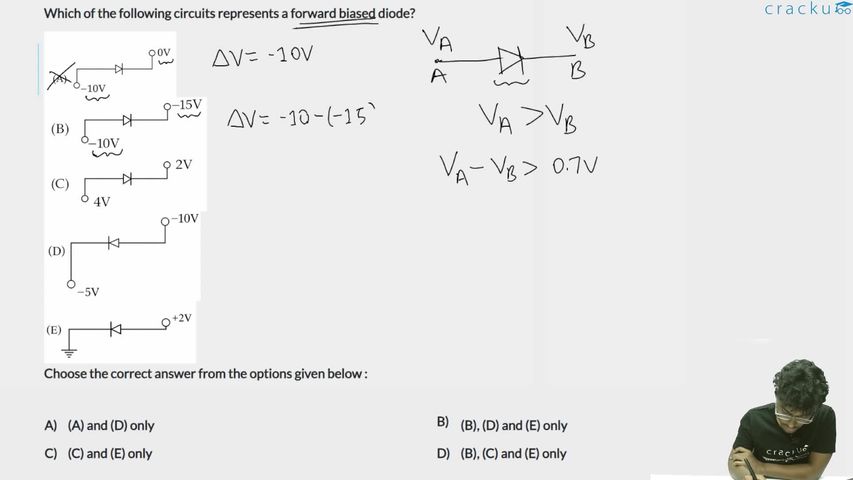
Which of the following circuits represents a forward biased diode?
Choose the correct answer from the options given below :
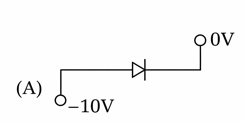
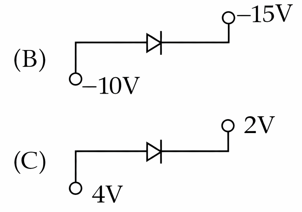
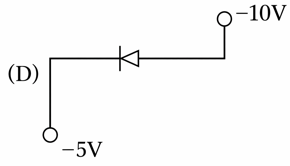
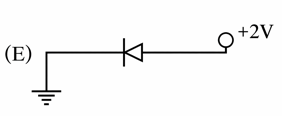
A p-n junction diode is forward biased when the electric potential at its p-side (anode, represented by the triangle) is strictly greater than the electric potential at its n-side (cathode, represented by the straight line). The condition for forward bias is $$V_p > V_n$$.
Option A: The p-side is connected to $$-10 \text{ V}$$ and the n-side is connected to $$0 \text{ V}$$. Since $$-10 \text{ V} < 0 \text{ V}$$, meaning $$V_p < V_n$$, this diode is reverse biased.
Option B: The p-side is connected to $$-10 \text{ V}$$ and the n-side is connected to $$-15 \text{ V}$$. Since $$-10 \text{ V} > -15 \text{ V}$$, meaning $$V_p > V_n$$, this diode is forward biased.
Option C: The p-side is connected to $$4 \text{ V}$$ and the n-side is connected to $$2 \text{ V}$$. Since $$4 \text{ V} > 2 \text{ V}$$, meaning $$V_p > V_n$$, this diode is also forward biased.
Option D: The n-side is connected to $$-5 \text{ V}$$ and the p-side is connected to $$-10 \text{ V}$$. Since $$-5 \text{ V} > -10 \text{ V}$$, meaning $$V_n> V_p$$, this diode is also reverse biased.
Option E: The n-side is connected to ground, which is $$0 \text{ V}$$, and the p-side is connected to $$+2 \text{ V}$$. Since $$0 \text{ V} < +2 \text{ V}$$, meaning $$V_n < V_p$$, this diode is forward biased.
Based on the explicit values shown in the provided circuit diagrams, circuits B, C, and E all represent forward biased diodes
Was this solution helpful?
Click on the Email ☝️ to Watch the Video Solution
Create a FREE account and get:
_1.webp)

Educational materials for JEE preparation

Ask our AI anything

AI can make mistakes. Please verify important information.
AI can make mistakes. Please verify important information.
