
Join Our JEE Preparation Group
Prep with like-minded aspirants; Get access to free daily tests and study material.
Sign in
Please select an account to continue using cracku.in
↓ →
Join Our JEE Preparation Group
Prep with like-minded aspirants; Get access to free daily tests and study material.
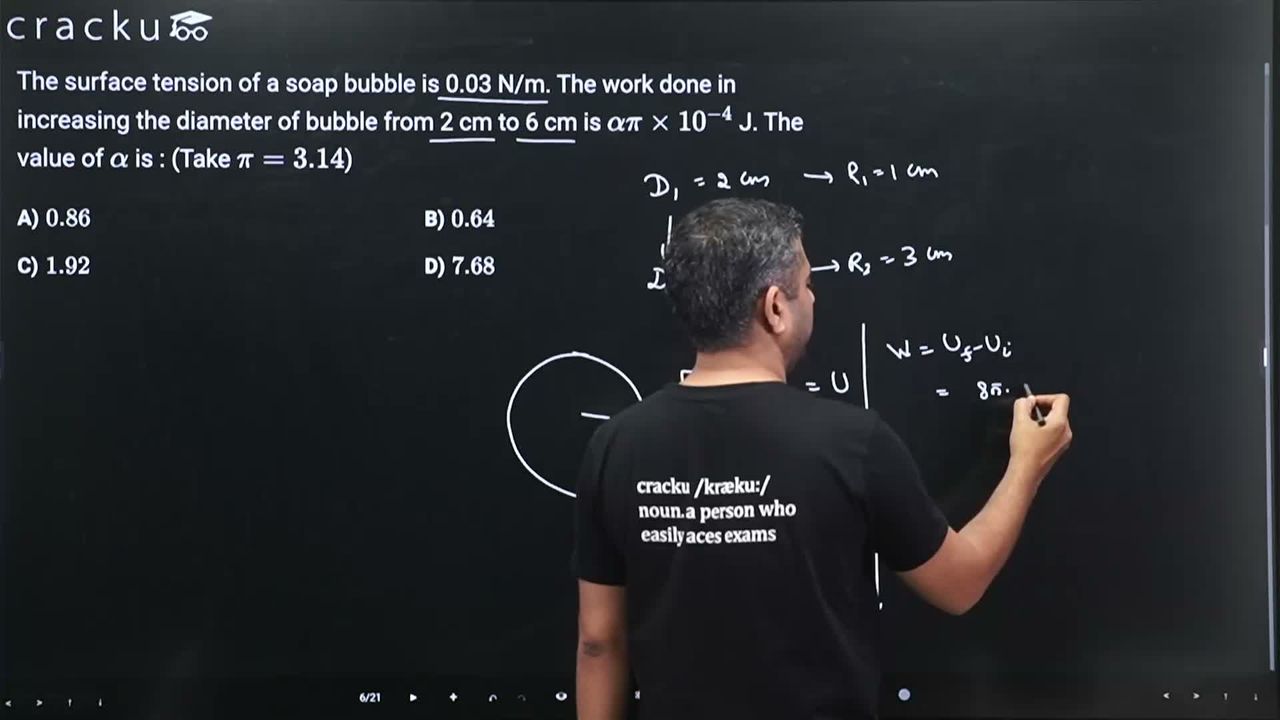
The surface tension of a soap bubble is 0.03 N/m. The work done in increasing the diameter of bubble from 2 cm to 6 cm is $$\alpha\pi \times 10^{-4}$$ J. The value of $$\alpha$$ is : (Take $$\pi = 3.14$$)
A soap bubble has TWO liquid surfaces (inner & outer).
Hence, to increase its size, the work done equals the increase in surface energy of both surfaces.
Surface tension is the energy per unit surface area. Therefore
$$\text{Work} = 2 \, T \, \Delta A$$
where $$T = 0.03 \, \text{N m}^{-1}$$ and $$\Delta A$$ is the change in surface area of ONE spherical surface.
Initial radius: $$r_1 = \frac{2 \text{ cm}}{2} = 1 \text{ cm} = 0.01 \text{ m}$$
Final radius: $$r_2 = \frac{6 \text{ cm}}{2} = 3 \text{ cm} = 0.03 \text{ m}$$
Surface area of a sphere is $$A = 4\pi r^2$$, so
$$\Delta A = 4\pi\left(r_2^{2} - r_1^{2}\right)$$
Substituting into the work-expression gives
$$W = 2T \, \Delta A = 2T \Bigl[4\pi\left(r_2^{2} - r_1^{2}\right)\Bigr] = 8\pi T\left(r_2^{2} - r_1^{2}\right)$$
Calculate $$r_2^{2} - r_1^{2}$$:
$$r_2^{2} - r_1^{2} = (0.03)^2 - (0.01)^2 = 0.0009 - 0.0001 = 0.0008 = 8 \times 10^{-4}$$
Now compute the work:
$$W = 8\pi (0.03)\,(8 \times 10^{-4})$$
$$\;\;= (8 \times 0.03 \times 8)\,\pi \times 10^{-4}$$
$$\;\;= 1.92\,\pi \times 10^{-4} \text{ J}$$
The question states the work as $$\alpha\pi \times 10^{-4} \text{ J}$$, so
$$\alpha = 1.92$$
Option C which is: $$1.92$$
Click on the Email ☝️ to Watch the Video Solution
Create a FREE account and get:
_1.webp)

Educational materials for JEE preparation

Ask our AI anything

AI can make mistakes. Please verify important information.
AI can make mistakes. Please verify important information.


