
Join Our JEE Preparation Group
Prep with like-minded aspirants; Get access to free daily tests and study material.
Sign in
Please select an account to continue using cracku.in
↓ →
Join Our JEE Preparation Group
Prep with like-minded aspirants; Get access to free daily tests and study material.
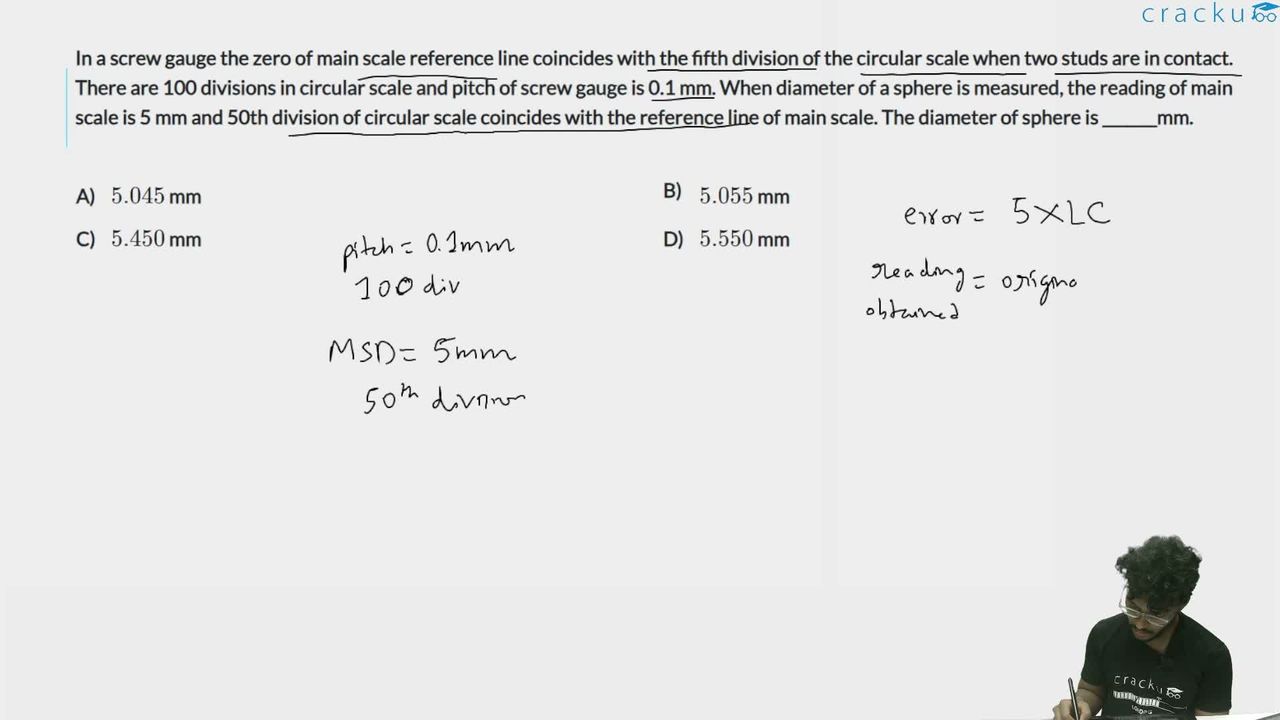
In a screw gauge the zero of main scale reference line coincides with the fifth division of the circular scale when two studs are in contact. There are 100 divisions in circular scale and pitch of screw gauge is 0.1 mm. When diameter of a sphere is measured, the reading of main scale is 5 mm and 50th division of circular scale coincides with the reference line of main scale. The diameter of sphere is _______mm.
The pitch of the screw gauge is given as $$0.1\text{ mm}$$ and the circular scale has $$100$$ equal divisions.
Least count (L.C.) of the screw gauge is therefore
$$\text{L.C.}= \frac{\text{pitch}}{\text{number of circular divisions}} = \frac{0.1\text{ mm}}{100}=0.001\text{ mm}$$
Zero error: When the two studs just touch, the zero on the main scale should coincide with the zero on the circular scale. Instead, the 5th circular division coincides with the reference line. Thus the screw shows an excess of
$$5 \times \text{L.C.}=5 \times 0.001 = 0.005\text{ mm}$$
Because the instrument reads more than the true length, the zero error is positive $$+0.005\text{ mm}$$. It must be subtracted from subsequent readings.
Reading with the sphere in place
Main-scale reading (MSR) $$= 5\text{ mm}$$
Circular-scale reading (CSR) $$= 50$$ divisions
Contribution of CSR $$= 50 \times \text{L.C.}=50 \times 0.001 = 0.050\text{ mm}$$
Observed diameter (before correction) $$= \text{MSR} + \text{CSR} = 5.000\text{ mm} + 0.050\text{ mm}=5.050\text{ mm}$$
Corrected diameter
$$\text{True diameter} = \text{observed reading} - (\text{positive zero error})$$
$$= 5.050\text{ mm} - 0.005\text{ mm}=5.045\text{ mm}$$
Hence, the diameter of the sphere is $$5.045\text{ mm}$$.
Option A which is: $$5.045$$ mm
Was this solution helpful?
Click on the Email ☝️ to Watch the Video Solution
Create a FREE account and get:
_1.webp)

Educational materials for JEE preparation

Ask our AI anything

AI can make mistakes. Please verify important information.
AI can make mistakes. Please verify important information.
