
Join Our JEE Preparation Group
Prep with like-minded aspirants; Get access to free daily tests and study material.
Sign in
Please select an account to continue using cracku.in
↓ →
Join Our JEE Preparation Group
Prep with like-minded aspirants; Get access to free daily tests and study material.
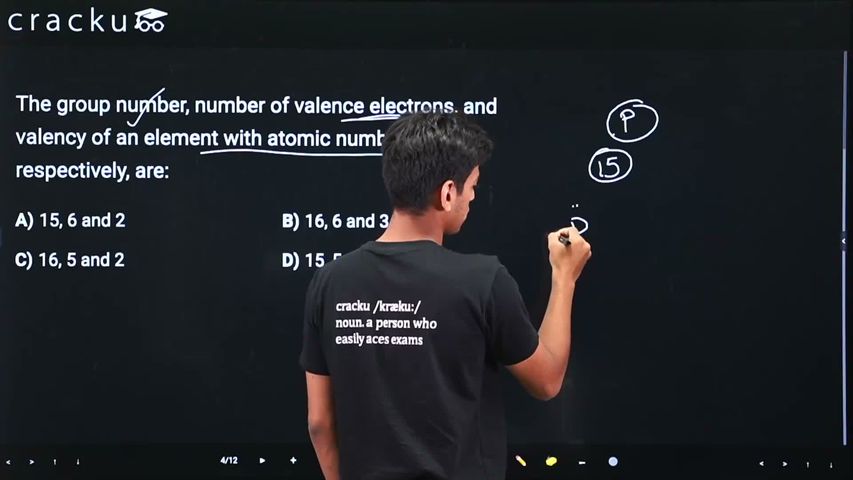
The group number, number of valence electrons, and valency of an element with atomic number 15, respectively, are:
We are given that the atomic number of the element is $$Z = 15$$. The atomic number tells us the total number of electrons in a neutral atom.
The electronic configuration is obtained by filling electrons in the order of increasing energy levels (Aufbau principle). The sequence of filling is $$1s \rightarrow 2s \rightarrow 2p \rightarrow 3s \rightarrow 3p \rightarrow 4s \dots$$ Distributing $$15$$ electrons step by step:
$$\begin{aligned} 1s &:& 2 \text{ electrons} \\ 2s &:& 2 \text{ electrons} \\ 2p &:& 6 \text{ electrons} \\ 3s &:& 2 \text{ electrons} \\ 3p &:& 3 \text{ electrons} \end{aligned}$$
So the condensed configuration is $$1s^2\,2s^2\,2p^6\,3s^2\,3p^3$$, which can be grouped as the shell distribution $$2,\,8,\,5$$.
We now identify the number of valence electrons. Valence electrons are those present in the outermost shell. From the distribution $$2,\,8,\,\color{blue}{5}$$ we see that the outermost (third) shell has $$5$$ electrons. Hence the number of valence electrons is $$5$$.
To find the modern IUPAC group number for a p-block element, we use the relation:
For a p-block representative element, $$\text{Group number} = 10 + \text{number of valence electrons}$$.
Substituting the valence electrons $$5$$, we get $$\text{Group number} = 10 + 5 = 15$$.
Next, we calculate the valency. For main-group elements, valency is the minimum number of electrons an atom gains, loses, or shares to achieve the nearest noble-gas configuration (octet). Because the element has $$5$$ valence electrons, it is easier for it to gain or share $$3$$ electrons to reach $$8$$.
Mathematically, $$\text{Valency} = 8 - \text{valence electrons} = 8 - 5 = 3.$$
So we have obtained:
$$\text{Group number} = 15, \qquad \text{Valence electrons} = 5, \qquad \text{Valency} = 3.$$
Comparing with the given options, this matches Option D.
Hence, the correct answer is Option D.
Was this solution helpful?
Click on the Email ☝️ to Watch the Video Solution
Create a FREE account and get:
_1.webp)

Educational materials for JEE preparation

Ask our AI anything

AI can make mistakes. Please verify important information.
AI can make mistakes. Please verify important information.
