
Join Our JEE Preparation Group
Prep with like-minded aspirants; Get access to free daily tests and study material.
Sign in
Please select an account to continue using cracku.in
↓ →
Join Our JEE Preparation Group
Prep with like-minded aspirants; Get access to free daily tests and study material.
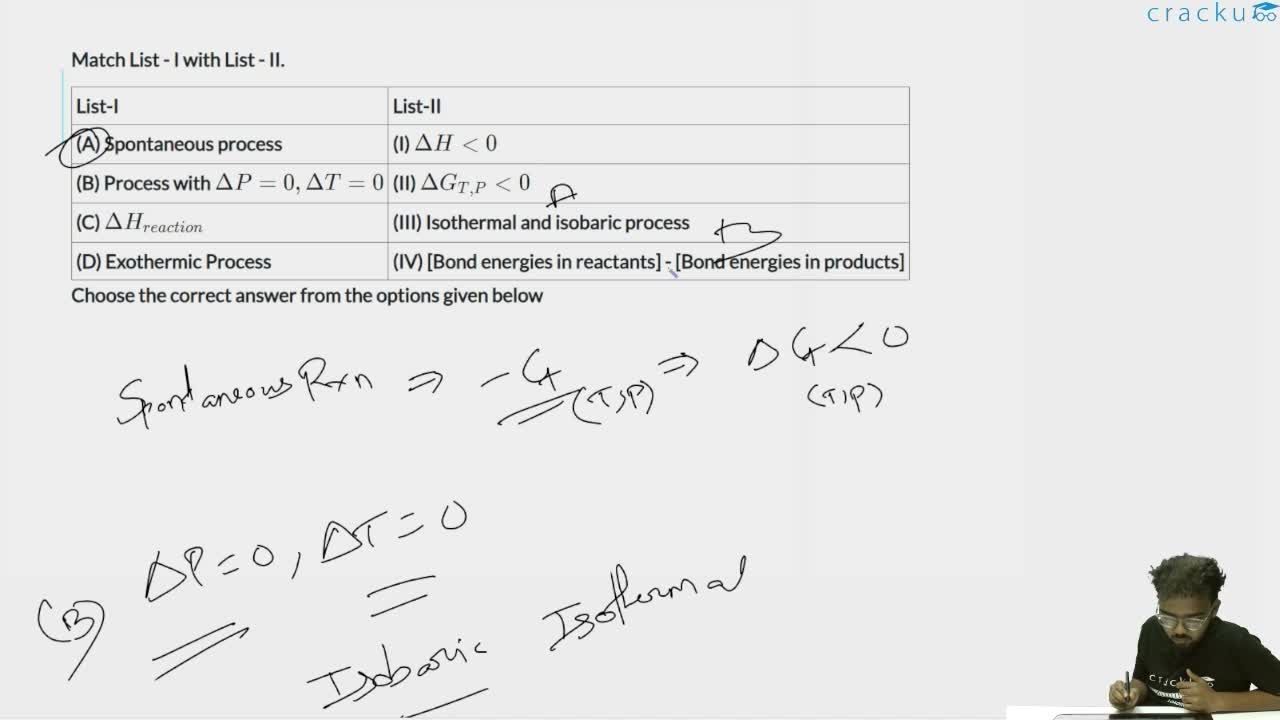
Match List - I with List - II.
| List-I | List-II |
|---|---|
| (A) Spontaneous process | (I) $$\Delta H < 0$$ |
| (B) Process with $$\Delta P = 0, \Delta T = 0$$ | (II) $$\Delta G_{T,P} < 0$$ |
| (C) $$\Delta H_{reaction}$$ | (III) Isothermal and isobaric process |
| (D) Exothermic Process | (IV) [Bond energies in reactants] - [Bond energies in products] |
Choose the correct answer from the options given below
We need to match chemical thermodynamics concepts from List-I with List-II.
Consider (A) the spontaneous process: a process is spontaneous when the Gibbs free energy change is negative at constant temperature and pressure, i.e., $$\Delta G_{T,P} < 0$$. This matches with (II).
Next, the process with $$\Delta P = 0, \Delta T = 0$$ indicates constant pressure and constant temperature, defining an isothermal and isobaric process. This corresponds to (III).
For (C), the reaction enthalpy $$\Delta H_{reaction}$$ can be calculated using bond energies as: $$\Delta H_{reaction}$$ = [Bond energies in reactants] - [Bond energies in products]. This matches with (IV). In contrast, an exothermic process releases heat, meaning $$\Delta H < 0$$, which corresponds to (I).
Therefore, the final matching is A → (II), B → (III), C → (IV), and D → (I). The correct answer is Option B.
Was this solution helpful?
Click on the Email ☝️ to Watch the Video Solution
Create a FREE account and get:
_1.webp)

Educational materials for JEE preparation

Ask our AI anything

AI can make mistakes. Please verify important information.
AI can make mistakes. Please verify important information.
