
Join Our JEE Preparation Group
Prep with like-minded aspirants; Get access to free daily tests and study material.
Sign in
Please select an account to continue using cracku.in
↓ →
Join Our JEE Preparation Group
Prep with like-minded aspirants; Get access to free daily tests and study material.
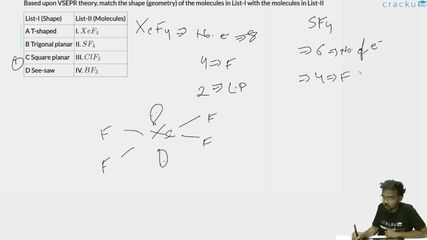
Based upon VSEPR theory, match the shape (geometry) of the molecules in List-I with the molecules in List-II
| List-I (Shape) | List-II (Molecules) |
|---|---|
| A T-shaped | I. $$XeF_4$$ |
| B Trigonal planar | II. $$SF_4$$ |
| C Square planar | III. $$ClF_3$$ |
| D See-saw | IV. $$BF_3$$ |
We use VSEPR theory to determine the molecular geometry of each molecule in List-II:
XeF$$_4$$ (I): Xe has 8 valence electrons. Four are used for bonding with F atoms, leaving 2 lone pairs. Total electron pairs = 6 (octahedral arrangement). With 4 bonding pairs and 2 lone pairs (in trans positions), the shape is square planar.
SF$$_4$$ (II): S has 6 valence electrons. Four are used for bonding with F atoms, leaving 1 lone pair. Total electron pairs = 5 (trigonal bipyramidal arrangement). With 4 bonding pairs and 1 lone pair, the shape is see-saw (distorted tetrahedron).
ClF$$_3$$ (III): Cl has 7 valence electrons. Three are used for bonding with F atoms, leaving 2 lone pairs. Total electron pairs = 5 (trigonal bipyramidal arrangement). With 3 bonding pairs and 2 lone pairs (both in equatorial positions), the shape is T-shaped.
BF$$_3$$ (IV): B has 3 valence electrons. All three are used for bonding with F atoms, leaving 0 lone pairs. Total electron pairs = 3. The shape is trigonal planar.
Matching: A (T-shaped) → III (ClF$$_3$$), B (Trigonal planar) → IV (BF$$_3$$), C (Square planar) → I (XeF$$_4$$), D (See-saw) → II (SF$$_4$$).
The answer is Option D: A-(III), B-(IV), C-(I), D-(II).
Was this solution helpful?
Click on the Email ☝️ to Watch the Video Solution
Create a FREE account and get:
_1.webp)

Educational materials for JEE preparation

Ask our AI anything

AI can make mistakes. Please verify important information.
AI can make mistakes. Please verify important information.
