
Join Our JEE Preparation Group
Prep with like-minded aspirants; Get access to free daily tests and study material.
Sign in
Please select an account to continue using cracku.in
↓ →
Join Our JEE Preparation Group
Prep with like-minded aspirants; Get access to free daily tests and study material.
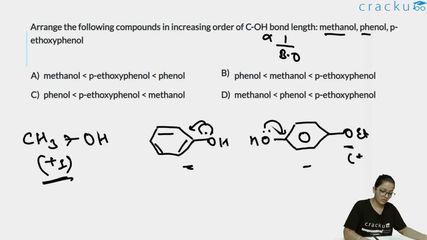
Arrange the following compounds in increasing order of C-OH bond length: methanol, phenol, p-ethoxyphenol
First, we recall a general principle of chemical bonding: a bond becomes shorter as its bond order increases. In other words, if a C‒O linkage behaves partly like a double bond, its length will be smaller than that of a pure single bond. Symbolically one may say
Greater partial double bond character $$\; \Longrightarrow\; \text{shorter } \mathrm{C-O}$$ bond length $$.$$
Now we examine every molecule one by one.
Methanol, $$\mathrm{CH_3OH}$$. In methanol the $$\mathrm{C-O}$$ bond is an ordinary $$\sigma$$ single bond. There is no resonance that can impart any double-bond character to this linkage, so the bond order is exactly 1 and the bond is comparatively long.
Phenol, $$\mathrm{C_6H_5OH}$$. The lone pair on the oxygen atom can overlap with the $$\pi$$ system of the benzene ring. We write the main resonance contributors as
$$\mathrm{C_6H_5-OH} \;\;\leftrightarrow\;\; \mathrm{C_6H_5-O^{+}=H} \;-\;$$ (ring bears a negative charge at the ortho/para positions) $$.$$
This resonance places a partial $$\mathrm{C=O}$$ double bond between the ring carbon and the oxygen, raising the bond order above 1. Because of this extra double-bond character, the $$\mathrm{C-O}$$ bond in phenol is shorter than that in methanol.
p-Ethoxyphenol, $$\mathrm{HO\!-\!C_6H_4\!-\!OCH_2CH_3}$$. Here an ethoxy group $$\left(+M\right)$$ sits para to the hydroxyl group. The ethoxy substituent donates electron density into the ring through resonance:
$$\mathrm{-OCH_2CH_3}\;\; \longrightarrow\;\; \text{ring}.$$
Because the ring is now richer in electrons, it needs to draw less electron density from the oxygen of the $$\mathrm{OH}$$ group. Consequently the resonance form in which the $$\mathrm{C-O}$$ bond is double contributes less than in simple phenol. The partial double-bond character of the $$\mathrm{C-O}$$ bond is therefore weakened, the bond order moves a little closer to 1, and the bond length increases slightly relative to phenol, though it still remains shorter than the pure single bond of methanol.
Putting all three observations together, the increasing order of $$\mathrm{C-O}$$ bond length is
$$\text{phenol} \;<\;$$ p-ethoxyphenol $$\;<\; \text{methanol} .$$
Comparing this sequence with the given options, we match
Option C: phenol < p-ethoxyphenol < methanol.
Hence, the correct answer is Option C.
Was this solution helpful?
Click on the Email ☝️ to Watch the Video Solution
Create a FREE account and get:
_1.webp)

Educational materials for JEE preparation

Ask our AI anything

AI can make mistakes. Please verify important information.
AI can make mistakes. Please verify important information.
