
Join Our JEE Preparation Group
Prep with like-minded aspirants; Get access to free daily tests and study material.
Sign in
Please select an account to continue using cracku.in
↓ →
Join Our JEE Preparation Group
Prep with like-minded aspirants; Get access to free daily tests and study material.
The four quantum numbers for the electron in the outer most orbital of potassium (atomic no. 19) are
We need to find the four quantum numbers for the outermost electron of potassium (K, atomic number 19).
The four quantum numbers that describe an electron are the principal quantum number $$n$$, which determines the energy level or shell; the azimuthal quantum number $$l$$, which determines the subshell ($$l = 0$$ for s, $$l = 1$$ for p, $$l = 2$$ for d); the magnetic quantum number $$m$$, which ranges from $$-l$$ to $$+l$$; and the spin quantum number $$s$$, which can be either $$+\frac{1}{2}$$ or $$-\frac{1}{2}$$.
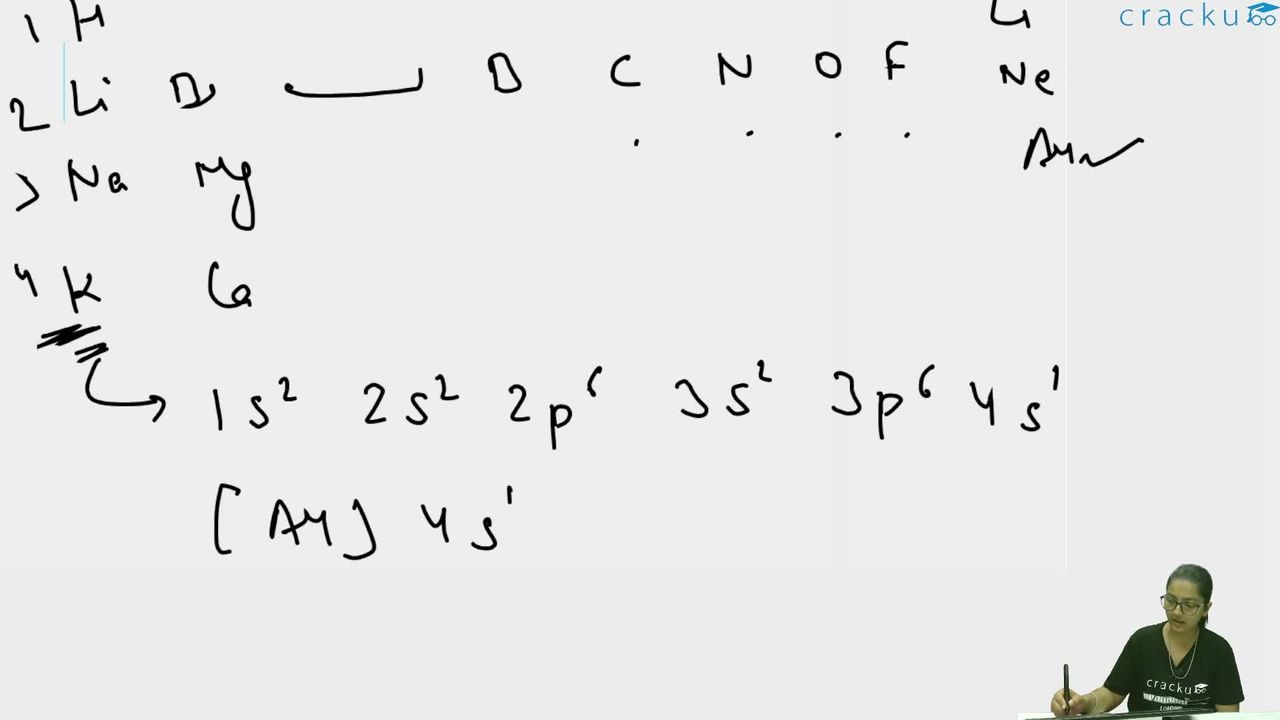
Following the Aufbau principle (filling order by increasing energy), the electron configuration of potassium (Z = 19) is $$\text{K}: 1s^2 \, 2s^2 \, 2p^6 \, 3s^2 \, 3p^6 \, 4s^1$$, which can also be written as $$[\text{Ar}] \, 4s^1$$ because the 4s subshell (n + l = 4 + 0 = 4) has a lower energy than the 3d subshell (n + l = 3 + 2 = 5).
Therefore, the outermost (valence) electron occupies the $$4s$$ orbital, for which the principal quantum number is $$n = 4$$, the azimuthal quantum number is $$l = 0$$, the magnetic quantum number is $$m = 0$$ (the only possible value when $$l = 0$$), and the spin quantum number is $$s = +\frac{1}{2}$$ (by convention, the first electron in an orbital has spin +1/2).
The correct answer is Option (2): $$n = 4, l = 0, m = 0, s = +\frac{1}{2}$$.
Was this solution helpful?
Click on the Email ☝️ to Watch the Video Solution
Create a FREE account and get:
_1.webp)

Educational materials for JEE preparation

Ask our AI anything

AI can make mistakes. Please verify important information.
AI can make mistakes. Please verify important information.
