
Join Our JEE Preparation Group
Prep with like-minded aspirants; Get access to free daily tests and study material.
Sign in
Please select an account to continue using cracku.in
↓ →
Join Our JEE Preparation Group
Prep with like-minded aspirants; Get access to free daily tests and study material.
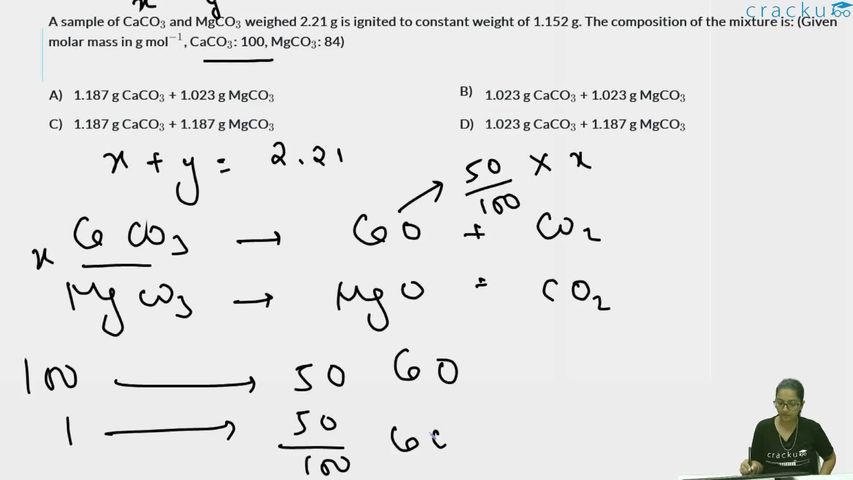
A sample of CaCO$$_3$$ and MgCO$$_3$$ weighed 2.21 g is ignited to constant weight of 1.152 g. The composition of the mixture is: (Given molar mass in g mol$$^{-1}$$, CaCO$$_3$$: 100, MgCO$$_3$$: 84)
We need to find the composition of a mixture of CaCO$$_3$$ and MgCO$$_3$$ that weighs 2.21 g and leaves a residue of 1.152 g after ignition.
When carbonates are heated (ignited), they decompose to form the corresponding metal oxides and carbon dioxide:
$$\text{CaCO}_3 \xrightarrow{\Delta} \text{CaO} + \text{CO}_2$$
$$\text{MgCO}_3 \xrightarrow{\Delta} \text{MgO} + \text{CO}_2$$
We set up variables by letting $$x$$ represent the mass of CaCO$$_3$$ and $$y$$ represent the mass of MgCO$$_3$$, and since their total mass is 2.21 g, we have
$$x + y = 2.21 \quad \text{...(1)}$$
Next, we calculate the mass of oxide produced from each carbonate.
Since the molar mass of CaCO$$_3$$ is 100, $$x$$ g of CaCO$$_3$$ yields $$\frac{56}{100}\times x$$ g of CaO, given that the molar mass of CaO is 56.
Similarly, because the molar mass of MgCO$$_3$$ is 84, $$y$$ g of MgCO$$_3$$ produces $$\frac{40}{84}\times y$$ g of MgO, with MgO having a molar mass of 40.
The total residue mass therefore leads to the second equation:
$$\frac{56}{100}x + \frac{40}{84}y = 1.152$$
which simplifies to $$0.56x + 0.4762y = 1.152 \quad \text{...(2)}$$
Substituting $$x = 2.21 - y$$ from equation (1) into equation (2) yields:
$$0.56(2.21 - y) + 0.4762y = 1.152$$
which expands to $$1.2376 - 0.56y + 0.4762y = 1.152$$
or $$1.2376 - 0.0838y = 1.152$$
Rearranging gives $$-0.0838y = 1.152 - 1.2376 = -0.0856$$,
and hence $$y = \frac{0.0856}{0.0838} = 1.0215 \approx 1.023 \, \text{g}$$
Then $$x = 2.21 - 1.023 = 1.187 \, \text{g}$$
Verification shows $$0.56 \times 1.187 + 0.4762 \times 1.023 = 0.6647 + 0.4872 = 1.1519 \approx 1.152$$, confirming consistency.
The mixture contains 1.187 g of CaCO$$_3$$ and 1.023 g of MgCO$$_3$$.
The correct answer is Option (1): 1.187 g CaCO$$_3$$ + 1.023 g MgCO$$_3$$.
Was this solution helpful?
Click on the Email ☝️ to Watch the Video Solution
Create a FREE account and get:
_1.webp)

Educational materials for JEE preparation

Ask our AI anything

AI can make mistakes. Please verify important information.
AI can make mistakes. Please verify important information.
