
Join Our JEE Preparation Group
Prep with like-minded aspirants; Get access to free daily tests and study material.
Sign in
Please select an account to continue using cracku.in
↓ →
Join Our JEE Preparation Group
Prep with like-minded aspirants; Get access to free daily tests and study material.
Given below are two statements: One is labelled as Assertion A and the other is labelled as Reason R.
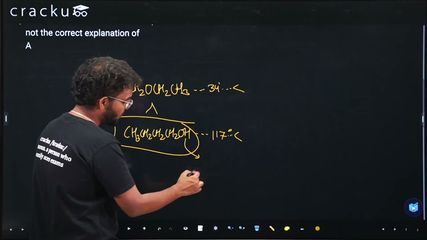
Assertion A: Butan-1-ol has higher boiling point than ethoxyethane.
Reason R: Extensive hydrogen bonding leads to stronger association of molecules.
In the light of the above statements, choose the correct answer from the options given below :
Assertion A: Butan-1-ol has higher boiling point than ethoxyethane (diethyl ether).
Reason R: Extensive hydrogen bonding leads to stronger association of molecules.
Analysis of Assertion A:
Butan-1-ol (CH₃CH₂CH₂CH₂OH) has a boiling point of approximately 117.7°C.
Ethoxyethane (CH₃CH₂OCH₂CH₃, diethyl ether) has a boiling point of approximately 34.6°C.
Both have the same molecular formula C₄H₁₀O, but butan-1-ol has a significantly higher boiling point.
Assertion A is True.
Analysis of Reason R:
Butan-1-ol has an -OH group capable of forming extensive intermolecular hydrogen bonds, leading to stronger molecular association and higher boiling point. Ethoxyethane cannot form H-bonds with itself (no O-H or N-H groups).
Reason R is True and correctly explains Assertion A.
The correct answer is Option B: Both A and R are true and R is the correct explanation of A.
Was this solution helpful?
Click on the Email ☝️ to Watch the Video Solution
Create a FREE account and get:
_1.webp)

Educational materials for JEE preparation

Ask our AI anything

AI can make mistakes. Please verify important information.
AI can make mistakes. Please verify important information.
