
Join Our JEE Preparation Group
Prep with like-minded aspirants; Get access to free daily tests and study material.
Sign in
Please select an account to continue using cracku.in
↓ →
Join Our JEE Preparation Group
Prep with like-minded aspirants; Get access to free daily tests and study material.
Six charges are placed around a regular hexagon of side length $$a$$ as shown in the figure. Five of them have charge $$q$$, and the remaining one has charge $$x$$. The perpendicular from each charge to the nearest hexagon side passes through the center O of the hexagon and is bisected by the side.
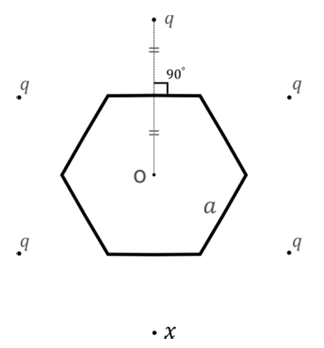
Which of the following statement(s) is(are) correct in SI units?
Let the six charges be placed at the six vertices of a regular hexagon of side length $$a$$. For a regular hexagon the distance of every vertex from the centre $$O$$ (the circumscribed radius) is also equal to $$a$$. Therefore, for every charge the distance to the point $$O$$ is
$$r = a$$
Denote $$k = \dfrac{1}{4\pi \epsilon_0}$$ for brevity.
Electric field at $$O$$
For a point charge the magnitude of the electric field at a distance $$r$$ is
$$E = k \dfrac{q}{r^{2}}$$ and it is directed along the line joining the charge to the point of observation.
Label the six vertices in order as $$1,2,3,4,5,6$$ with vertex 1 on the positive $$x$$-axis. Five of the charges are $$q$$ and the sixth (placed at vertex 1) is $$x$$.
The six radial directions are separated by $$60^\circ$$. If all six charges were equal to $$q$$ the vector sum of the six fields would be zero because the six vectors form a closed regular hexagon. Hence
$$\sum_{i=1}^{6} \mathbf{E}_i(q) = \mathbf{0}$$
When the charge at vertex 1 is changed from $$q$$ to $$x$$, every field vector except the one coming from vertex 1 remains the same. Thus the resultant field becomes
$$\mathbf{E}_{\text{net}} = \mathbf{E}_1(x) + \sum_{i=2}^{6} \mathbf{E}_i(q) = \mathbf{E}_1(x) - \mathbf{E}_1(q)$$
The two vectors on the right-hand side have the same line of action (the radius through vertex 1), so the net magnitude is
$$E_{\text{net}} = k\,\dfrac{|x-q|}{a^{2}}$$
Special cases:
• When $$x = q$$, $$E_{\text{net}} = 0$$.
• When $$x = -q$$, $$E_{\text{net}} = k\,\dfrac{2q}{a^{2}}
= \dfrac{q}{2\pi\epsilon_0 a^{2}}$$.
Option B claims the value $$\dfrac{q}{6\pi\epsilon_0 a^{2}}$$, which differs by a factor of $$\dfrac13$$ and is therefore incorrect.
Electric potential at $$O$$
The potential produced by a point charge at distance $$r$$ is
$$V = k \dfrac{q}{r}$$ (scalar quantity).
With five charges equal to $$q$$ and one charge equal to $$x$$ the total potential is
$$V_{\text{net}} = k\,\dfrac{5q + x}{a}$$
Special cases:
• For $$x = 2q$$, $$V_{\text{net}} = k\,\dfrac{7q}{a}
= \dfrac{7q}{4\pi\epsilon_0 a}$$.
Option C contains the extra factor $$\sqrt{3}$$ in the denominator, so it is incorrect.
• For $$x = -3q$$, $$V_{\text{net}} = k\,\dfrac{2q}{a}
= \dfrac{q}{2\pi\epsilon_0 a}$$.
Option D again has the spurious factor $$\sqrt{3}$$ and a different numerical multiplier, hence is incorrect.
Conclusion: only the statement in Option A is correct.
Correct choice: Option A which is: When $$x = q$$, the magnitude of the electric field at $$O$$ is zero.
Create a FREE account and get:
_1.webp)

Educational materials for JEE preparation

Ask our AI anything

AI can make mistakes. Please verify important information.
AI can make mistakes. Please verify important information.


