
Join Our JEE Preparation Group
Prep with like-minded aspirants; Get access to free daily tests and study material.
Sign in
Please select an account to continue using cracku.in
↓ →
Join Our JEE Preparation Group
Prep with like-minded aspirants; Get access to free daily tests and study material.
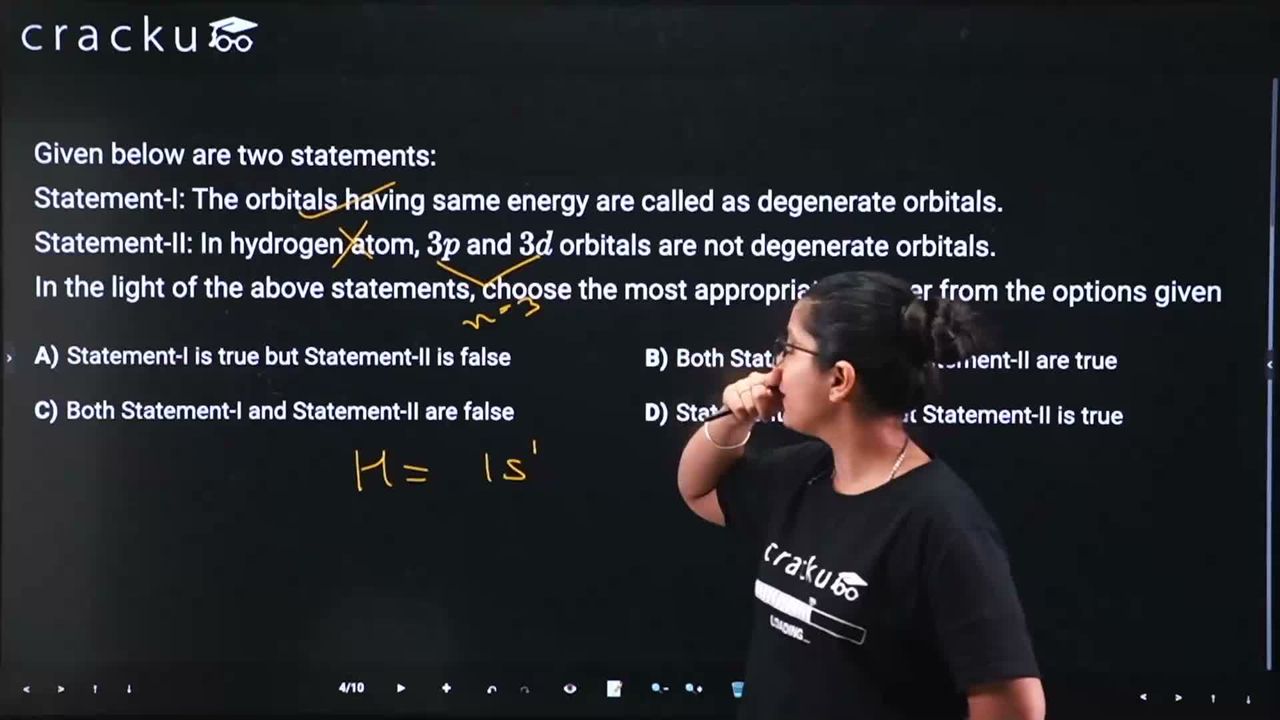
Given below are two statements:
Statement-I: The orbitals having same energy are called as degenerate orbitals.
Statement-II: In hydrogen atom, $$3p$$ and $$3d$$ orbitals are not degenerate orbitals.
In the light of the above statements, choose the most appropriate answer from the options given
Statement I: "The orbitals having same energy are called as degenerate orbitals."
This is the correct definition of degenerate orbitals. Orbitals that have the same energy are called degenerate. Statement I is TRUE.
Statement II: "In hydrogen atom, $$3p$$ and $$3d$$ orbitals are not degenerate orbitals."
In a hydrogen atom (single-electron system), the energy of an orbital depends only on the principal quantum number $$n$$, not on the azimuthal quantum number $$l$$. Therefore, all orbitals with the same $$n$$ have the same energy.
Since $$3p$$ ($$n=3, l=1$$) and $$3d$$ ($$n=3, l=2$$) both have $$n = 3$$, they have the same energy in a hydrogen atom and are degenerate.
(Note: In multi-electron atoms, $$3p$$ and $$3d$$ would NOT be degenerate due to electron-electron repulsion and shielding effects. But in hydrogen atom specifically, they are degenerate.)
Statement II is FALSE.
The correct answer is: Statement-I is true but Statement-II is false.
Was this solution helpful?
Click on the Email ☝️ to Watch the Video Solution
Create a FREE account and get:
_1.webp)

Educational materials for JEE preparation

Ask our AI anything

AI can make mistakes. Please verify important information.
AI can make mistakes. Please verify important information.
