
Join Our JEE Preparation Group
Prep with like-minded aspirants; Get access to free daily tests and study material.
Sign in
Please select an account to continue using cracku.in
↓ →
Join Our JEE Preparation Group
Prep with like-minded aspirants; Get access to free daily tests and study material.
A rod of length 5L is bent right angle keeping one side length as 2L.
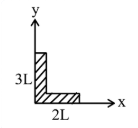
The position of the centre of mass of the system: (Consider L = 10 cm)
The bent rod can be treated as two uniform rods of lengths $$3L$$ and $$2L$$ joined at the corner.
For the horizontal rod, its centre of mass is at $$x_1=L,\qquad y_1=0$$
For the vertical rod, its centre of mass is at $$x_2=0,\qquad y_2=\frac{3L}{2}$$
Since the rod is uniform, mass is proportional to length.
Thus, $$x_{cm}=\frac{(2L)(L)+(3L)(0)}{5L}$$
$$x_{cm}=\frac{2L}{5}$$
Similarly, $$y_{cm}=\frac{(2L)(0)+(3L)\left(\frac{3L}{2}\right)}{5L}$$
$$y_{cm}=\frac{9L}{10}$$
Given, $$L=10\ \mathrm{cm}$$
Therefore, $$x_{cm}=4\ \mathrm{cm}$$
$$y_{cm}=9\ \mathrm{cm}$$
Hence, the position vector of the centre of mass is $${4\hat{i}+9\hat{j}\ \mathrm{cm}}$$
Hence, the correct option is D.

Click on the Email ☝️ to Watch the Video Solution
Create a FREE account and get:
_1.webp)

Educational materials for JEE preparation

Ask our AI anything

AI can make mistakes. Please verify important information.
AI can make mistakes. Please verify important information.


