
Join Our JEE Preparation Group
Prep with like-minded aspirants; Get access to free daily tests and study material.
Sign in
Please select an account to continue using cracku.in
↓ →
Join Our JEE Preparation Group
Prep with like-minded aspirants; Get access to free daily tests and study material.
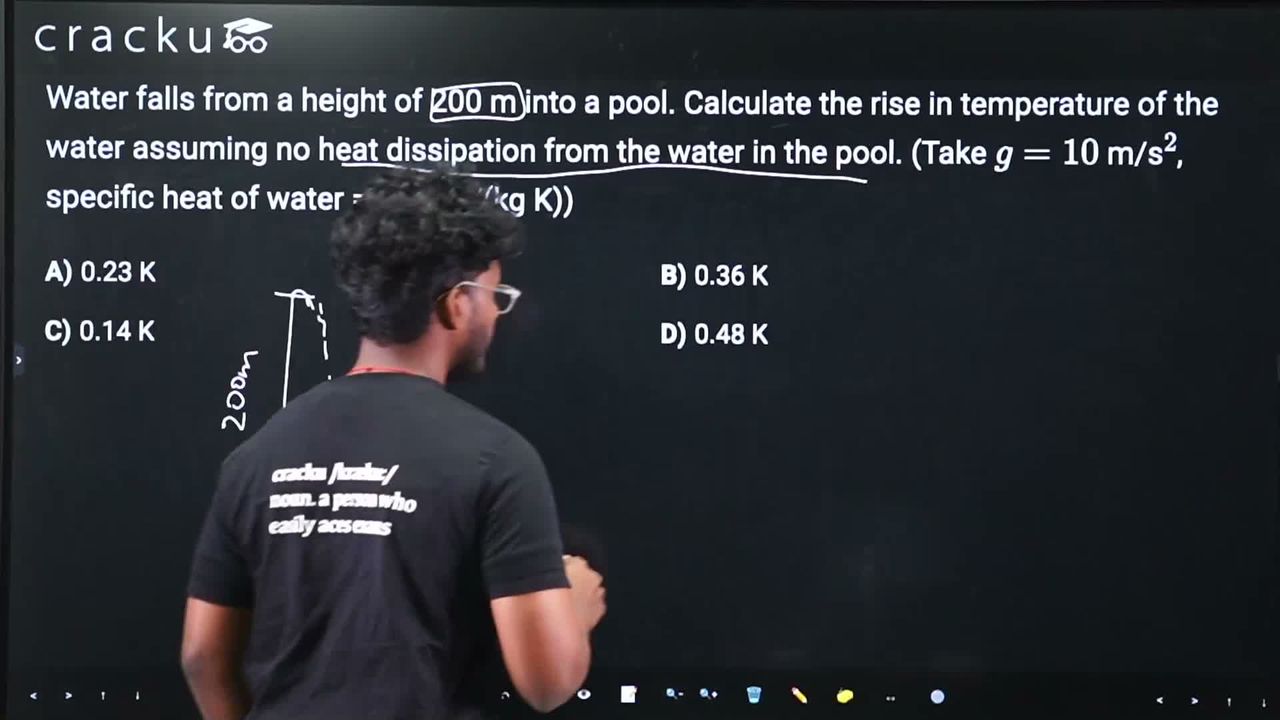
Water falls from a height of 200 m into a pool. Calculate the rise in temperature of the water assuming no heat dissipation from the water in the pool. (Take $$g = 10$$ m/s$$^2$$, specific heat of water = 4200 J/(kg K))
When water falls freely, its gravitational potential energy is converted into internal energy (heat) on reaching the pool.
Ignoring any heat loss to the surroundings, the gain in internal energy raises the water’s temperature.
For a mass $$m$$ of water falling through height $$h$$, the potential energy lost is
$$\text{Potential energy} = m g h$$
This energy appears as heat: $$m c \Delta T$$, where $$c$$ is the specific heat capacity and $$\Delta T$$ is the rise in temperature.
Equating the two energies:
$$m g h = m c \Delta T$$
Cancel the common factor $$m$$ (mass of water):
$$g h = c \Delta T$$
Hence the temperature rise is
$$\Delta T = \frac{g h}{c}$$
Insert the given values: $$g = 10 \text{ m s}^{-2}$$, $$h = 200 \text{ m}$$, $$c = 4200 \text{ J kg}^{-1} \text{ K}^{-1}$$.
$$\Delta T = \frac{10 \times 200}{4200}$$
$$\Delta T = \frac{2000}{4200} = 0.476 \text{ K} \approx 0.48 \text{ K}$$
Therefore, the rise in temperature of the water is about $$0.48 \text{ K}$$.
Correct option: Option D (0.48 K)
Click on the Email ☝️ to Watch the Video Solution
Create a FREE account and get:
_1.webp)

Educational materials for JEE preparation

Ask our AI anything

AI can make mistakes. Please verify important information.
AI can make mistakes. Please verify important information.


