
Join Our JEE Preparation Group
Prep with like-minded aspirants; Get access to free daily tests and study material.
Sign in
Please select an account to continue using cracku.in
↓ →
Join Our JEE Preparation Group
Prep with like-minded aspirants; Get access to free daily tests and study material.
In such questions we first recall the definition of a redox (reduction-oxidation) reaction: it is a chemical change in which at least one element undergoes an increase in oxidation number (oxidation) while another element simultaneously shows a decrease in oxidation number (reduction). To decide which of the four given processes satisfies this condition, we calculate the oxidation numbers of every element on both sides of each reaction equation.
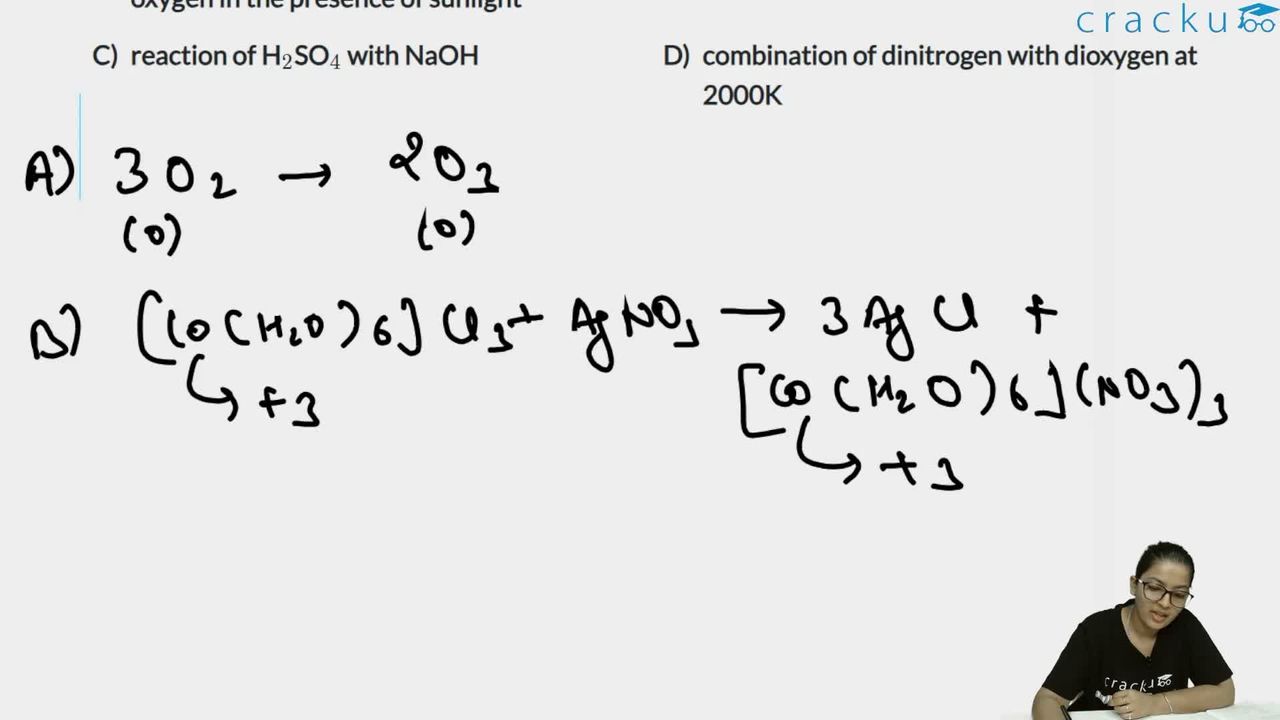
Let us begin with Option A, the photochemical conversion of di-oxygen to ozone. The skeletal equation is
$$3\;{\rm O_2}\;\xrightarrow{\text{sunlight}}\;2\;{\rm O_3}$$
In both $$\rm O_2$$ and $$\rm O_3$$ every oxygen atom is in the elemental state, so its oxidation number is $$0$$ on the left as well as on the right. Because no atom exhibits any change in oxidation number, this process is not redox.
Now we analyse Option B, the reaction between $$[{\rm Co(H_2O)_6}]^{3+}{\rm Cl_3^-}$$ and $$\rm AgNO_3$$. The molecular equation is
$$[{\rm Co(H_2O)_6}]{\rm Cl_3} + 3\;{\rm AgNO_3} \;\longrightarrow\;[{\rm Co(H_2O)_6}]{\rm (NO_3)_3} + 3\;{\rm AgCl}\downarrow$$
On both sides cobalt remains in the coordination sphere as $$\rm Co^{3+}$$, silver remains $$\rm Ag^{+}$$ in the ionic reagent and precipitated AgCl, chloride stays $$\rm Cl^-$$, nitrogen is $$+5$$ in each $$\rm NO_3^-$$ ion and oxygen is unchanged. Since no element experiences a change in oxidation number, this exchange of ions is a mere precipitation reaction, not a redox change.
We proceed to Option C, neutralisation of sulphuric acid with sodium hydroxide:
$$\rm H_2SO_4 + 2\,NaOH \;\longrightarrow\; Na_2SO_4 + 2\,H_2O$$
The oxidation numbers are as follows:
For sulphur in $$\rm H_2SO_4$$, applying the rule $$\sum \text{(oxidation numbers)} = \text{charge}$$, we have
$$2(+1) + x + 4(-2) = 0 \;\Longrightarrow\; x = +6$$
In $$\rm Na_2SO_4$$ the calculation
$$2(+1) + x + 4(-2) = 0 \;\Longrightarrow\; x = +6$$
gives the same value $$+6$$ for sulphur. Hydrogen is $$+1$$ in the acid and remains $$+1$$ in water; oxygen is $$-2$$ throughout; sodium is $$+1$$ on both sides. Thus the reaction involves no oxidation-number change and is therefore an acid-base, not a redox, process.
Finally, Option D describes the combination of gaseous dinitrogen with dioxygen at very high temperature (about $$2000\;{\rm K}$$):
$$\rm N_2 + O_2 \;\longrightarrow\; 2\,NO$$
We now assign oxidation numbers step by step. In their elemental forms $$\rm N_2$$ and $$\rm O_2$$ each atom possesses oxidation number $$0$$. For nitric oxide $$\rm NO$$, let the oxidation number of nitrogen be $$x$$; oxygen as usual in a neutral oxide is $$-2$$. Hence
$$x + (-2) = 0 \;\Longrightarrow\; x = +2$$
Therefore, nitrogen changes from $$0$$ to $$+2$$, which is an increase, i.e. oxidation. Concurrently oxygen changes from $$0$$ in $$\rm O_2$$ to $$-2$$ in $$\rm NO$$, a decrease, i.e. reduction. Both oxidation and reduction occur simultaneously in this single reaction, satisfying the criterion for a redox process.
Among the four alternatives, only the formation of nitric oxide in Option D exhibits simultaneous rise and fall of oxidation numbers. The other three processes show no such change.
Hence, the correct answer is Option 4.
Was this solution helpful?
Click on the Email ☝️ to Watch the Video Solution
Create a FREE account and get:
_1.webp)

Educational materials for JEE preparation

Ask our AI anything

AI can make mistakes. Please verify important information.
AI can make mistakes. Please verify important information.
