
Join Our JEE Preparation Group
Prep with like-minded aspirants; Get access to free daily tests and study material.
Sign in
Please select an account to continue using cracku.in
↓ →
Join Our JEE Preparation Group
Prep with like-minded aspirants; Get access to free daily tests and study material.
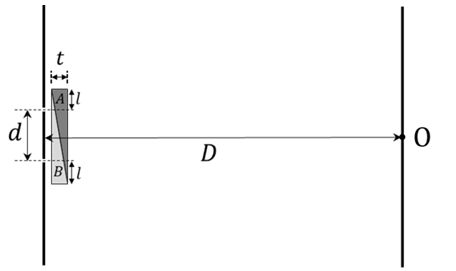
In a Young's double slit experiment, a combination of two glass wedges $$A$$ and $$B$$, having refractive indices 1.7 and 1.5, respectively, are placed in front of the slits, as shown in the figure. The separation between the slits is $$d = 2$$ mm and the shortest distance between the slits and the screen is $$D = 2$$ m. Thickness of the combination of the wedges is $$t = 12 \, \mu$$m. The value of $$l$$ as shown in the figure is 1 mm. Neglect any refraction effect at the slanted interface of the wedges. Due to the combination of the wedges, the central maximum shifts (in mm) with respect to O by ______.
Correct Answer: 1.2
Let the two slits be $$S_1$$ and $$S_2$$, separated by $$d = 2\;{\rm mm}$$.
The glass combination has a total (constant) physical thickness $$t = 12\;\mu{\rm m}$$ at every point, but the fractional thicknesses of the two glasses vary linearly along the length of the wedge, as shown in the figure.
Denote the thickness of glass A (refractive index $$n_A = 1.7$$) in front of a point on the slit plate by $$x$$.
Consequently, the thickness of glass B (refractive index $$n_B = 1.5$$) at the same point is $$t-x$$, because the total thickness remains $$t$$.
The slanted interface of the wedges makes the thickness of glass A change from $$0$$ to $$t$$ over the horizontal length $$l = 1\;{\rm mm}$$.
Therefore, the rate of change (slope) of thickness of glass A along the slit plate is
$$\frac{t}{l}= \frac{12\;\mu{\rm m}}{1\;{\rm mm}} = 12\;\frac{\mu{\rm m}}{{\rm mm}}$$
The two slits are $$d = 2\;{\rm mm}$$ apart. Hence the difference in the thickness of glass A present in front of the two slits is obtained by simple proportion (similar triangles):
$$\Delta x = \frac{t}{l}\times \frac{l}{2} = t\;\frac{l}{d} = 12\;\mu{\rm m}\;\times\;\frac{1\;{\rm mm}}{2\;{\rm mm}} = 6\;\mu{\rm m}$$
This means glass A is $$6\;\mu{\rm m}$$ thicker in front of one slit than in front of the other. Because the total thickness is fixed, glass B will automatically be $$6\;\mu{\rm m}$$ thinner at that slit:
$$t_{A1}-t_{A2}= +6\;\mu{\rm m}, \qquad t_{B1}-t_{B2}= -6\;\mu{\rm m}$$
The optical path length contributed by a layer of refractive index $$n$$ and physical thickness $$x$$ is $$(n-1)x$$ (extra path in excess of the same distance in air).
Hence the net path difference introduced between the two slits is
$$\delta_0 =(n_A-1)\,(t_{A1}-t_{A2})+(n_B-1)\,(t_{B1}-t_{B2}) =(n_A-n_B)\,\Delta x$$
Substituting the numerical values:
$$\delta_0 =(1.7-1.5)\times 6\;\mu{\rm m} =0.2\times 6\;\mu{\rm m} =1.2\;\mu{\rm m}$$
In Young’s double-slit arrangement, if one slit receives an additional optical path $$\delta_0$$, the point on the screen where the path difference due to geometry cancels this extra path is the new central maximum. For small angles (screen kept at distance $$D$$), the geometric path difference at a point $$y$$ from the original centre $$O$$ is $$\frac{d\,y}{D}$$. Setting the total path difference to zero gives
$$\frac{d\,y_0}{D} +\delta_0 = 0 \;\;\Longrightarrow\;\; |y_0| = \frac{D}{d}\,\delta_0$$
With $$D = 2\;{\rm m}=2000\;{\rm mm}$$ and $$d = 2\;{\rm mm}$$, we have
$$|y_0| = \frac{2000\;{\rm mm}}{2\;{\rm mm}} \times 1.2\;\mu{\rm m} = 1000 \times 1.2\times 10^{-3}\;{\rm mm} = 1.2\;{\rm mm}$$
Thus the central maximum shifts by $$1.2\;{\rm mm}$$ (towards the slit that has the smaller thickness of glass A).
Final answer: 1.2 mm
Was this solution helpful?
Create a FREE account and get:
_1.webp)

Educational materials for JEE preparation

Ask our AI anything

AI can make mistakes. Please verify important information.
AI can make mistakes. Please verify important information.
