
Join Our JEE Preparation Group
Prep with like-minded aspirants; Get access to free daily tests and study material.
Sign in
Please select an account to continue using cracku.in
↓ →
Join Our JEE Preparation Group
Prep with like-minded aspirants; Get access to free daily tests and study material.
The number of solutions of the equation $$\left(\dfrac{9}{x}-\dfrac{9}{\sqrt{x}}+2\right)\left(\dfrac{2}{x}-\dfrac{7}{\sqrt{x}}+3\right)=0$$ is:
We have: $$\left(\dfrac{9}{x}-\dfrac{9}{\sqrt{x}}+2\right)\left(\dfrac{2}{x}-\dfrac{7}{\sqrt{x}}+3\right)=0$$
Now, we know that x can't be 0 as it is in denominator and x can't be negative as it is in square root as well. Hence, x has to be strictly more than 0.
To make the equations easier, we can replace, $$y = \dfrac{1}{\sqrt{x}}$$ and $$y^2 = \dfrac{1}{x}$$.
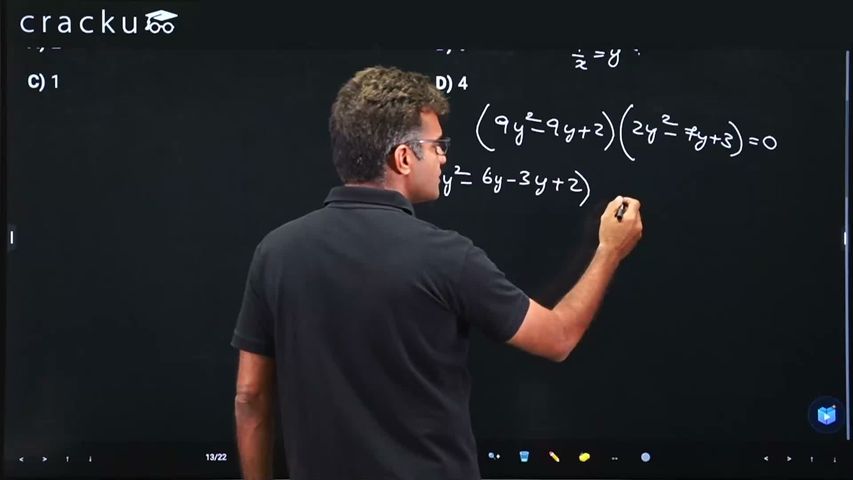
Replacing x, we get, $$(9y^2 - 9y + 2)(2y^2 - 7y + 3) = 0$$
Now, we can solve the equations individually.
Solving: $$9y^2 - 9y + 2 = 0$$
$$9y^2 - 6y - 3y + 2 = 0$$
$$3y(3y - 2) - 1(3y - 2) = 0$$
$$(3y - 1)(3y - 2) = 0$$
Hence, we get, $$y = \dfrac{1}{3} \quad \text{or} \quad y = \dfrac{2}{3}$$
Solving: $$2y^2 - 7y + 3 = 0$$
$$2y^2 - 6y - y + 3 = 0$$
$$2y(y - 3) - 1(y - 3) = 0$$
$$(2y - 1)(y - 3) = 0$$
Hence, we get: $$y = \dfrac{1}{2} \quad \text{or} \quad y = 3$$
So, we have got four valid, distinct values for $$y$$: $$\left\{\dfrac{1}{3}, \dfrac{2}{3}, \dfrac{1}{2}, 3\right\}$$
Converting back from y to x:
If $$y = \dfrac{1}{3}$$, then $$x = 9$$
If $$y = \dfrac{2}{3}$$, then $$x = \frac{9}{4}$$
If $$y = \dfrac{1}{2}$$, then $$x = 4$$
If $$y = 3$$, then $$x = \dfrac{1}{9}$$
All four $$x$$ values fall within our initial domain of $$x > 0$$.
Hence, the number of solutions to the equation is 4.
Was this solution helpful?
Click on the Email ☝️ to Watch the Video Solution
Create a FREE account and get:
_1.webp)

Educational materials for JEE preparation

Ask our AI anything

AI can make mistakes. Please verify important information.
AI can make mistakes. Please verify important information.
