
Join Our JEE Preparation Group
Prep with like-minded aspirants; Get access to free daily tests and study material.
Sign in
Please select an account to continue using cracku.in
↓ →
Join Our JEE Preparation Group
Prep with like-minded aspirants; Get access to free daily tests and study material.
A shell is fired from a fixed artillery gun with an initial speed u such that it hits the target on the ground at a distance R from it. If t$$_1$$ and t$$_2$$ are the values of the time taken by it to hit the target in two possible ways, the product t$$_1$$t$$_2$$ is:
We consider the usual equations for the motion of a projectile launched from ground level.
For an initial speed $$u$$ and an angle of projection $$\theta$$ with the horizontal, the time of flight is given by the well-known formula
$$t \;=\; \frac{2u\sin\theta}{g},$$
because the vertical component of velocity is $$u\sin\theta$$ and the projectile returns to the same vertical level after rising for $$u\sin\theta/g$$ seconds and falling for the same duration.
The horizontal range reached in that flight is, by the standard range formula,
$$R \;=\; \frac{u^{2}\sin2\theta}{g}.$$
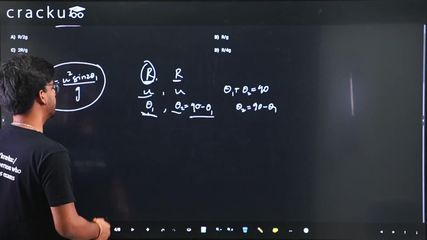
We are told that the shell actually lands at the given distance $$R$$ from the gun, and that two different angles of projection are possible. Let those angles be $$\theta_{1}$$ and $$\theta_{2}$$, with the corresponding times of flight $$t_{1}$$ and $$t_{2}$$.
Since both angles produce the same range, we must have
$$\sin2\theta_{1} \;=\; \sin2\theta_{2} \;=\; \frac{gR}{u^{2}}.$$
Because $$\sin(180^{\circ}-\alpha)=\sin\alpha$$, the two values of $$2\theta$$ that give the same sine add up to $$180^{\circ}$$, so
$$2\theta_{1} + 2\theta_{2} = 180^{\circ} \;\;\Longrightarrow\;\; \theta_{1} + \theta_{2} = 90^{\circ}.$$
Now their times of flight, from the first formula, are
$$t_{1} = \frac{2u\sin\theta_{1}}{g}, \quad t_{2} = \frac{2u\sin\theta_{2}}{g}.$$
We multiply these two expressions to obtain the required product:
$$ t_{1}t_{2} = \left(\frac{2u\sin\theta_{1}}{g}\right)\!\!\left(\frac{2u\sin\theta_{2}}{g}\right) = \frac{4u^{2}}{g^{2}}\,\sin\theta_{1}\sin\theta_{2}. $$
Because $$\theta_{1}+\theta_{2}=90^{\circ}$$, we may write $$\sin\theta_{2}=\cos\theta_{1}$$, giving
$$\sin\theta_{1}\sin\theta_{2} = \sin\theta_{1}\cos\theta_{1} = \tfrac12\sin2\theta_{1}.$$
But from the range equality stated earlier,
$$\sin2\theta_{1} = \frac{gR}{u^{2}}.$$
Substituting this into the product of sines gives
$$\sin\theta_{1}\sin\theta_{2} = \tfrac12 \left(\frac{gR}{u^{2}}\right) = \frac{gR}{2u^{2}}.$$
Putting this back into the expression for $$t_{1}t_{2}$$, we have
$$ t_{1}t_{2} = \frac{4u^{2}}{g^{2}} \times \frac{gR}{2u^{2}} = \frac{4}{g^{2}}\times\frac{gR}{2} = \frac{2R}{g}. $$
Thus
$$t_{1}t_{2} = \frac{2R}{g}.$$
Hence, the correct answer is Option C.
Was this solution helpful?
Click on the Email ☝️ to Watch the Video Solution
Create a FREE account and get:
_1.webp)

Educational materials for JEE preparation

Ask our AI anything

AI can make mistakes. Please verify important information.
AI can make mistakes. Please verify important information.
