
Join Our JEE Preparation Group
Prep with like-minded aspirants; Get access to free daily tests and study material.
Sign in
Please select an account to continue using cracku.in
↓ →
Join Our JEE Preparation Group
Prep with like-minded aspirants; Get access to free daily tests and study material.
The trajectory of a projectile near the surface of the earth is given as $$y = 2x - 9x^2$$. If it were launched at an angle $$\theta_0$$ with speed $$v_0$$ then g = 10 m s$$^{-2}$$:
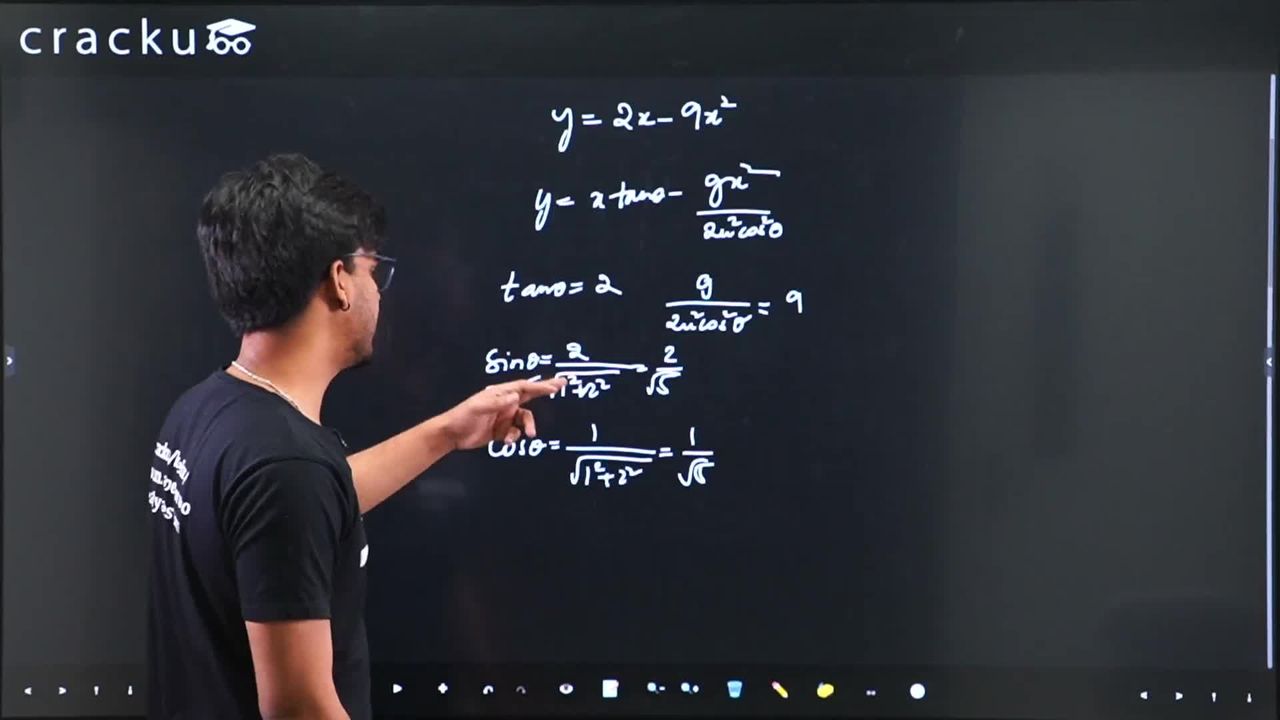
For the motion of a projectile close to the surface of the earth (neglecting air resistance) the standard Cartesian equation of the trajectory is first written. We have the well-known result
$$y = x\tan\theta_0 - \frac{g\,x^2}{2\,v_0^{\;2}\cos^{2}\theta_0}.$$
In this formula $$\theta_0$$ is the angle of projection with the horizontal, $$v_0$$ is the initial speed and $$g$$ is the magnitude of the acceleration due to gravity.
The question gives the actual path followed by the projectile as
$$y = 2x - 9x^{2}.$$
Because two different expressions describe the same curve they must be identical term by term in powers of $$x$$. Therefore we compare the coefficient of $$x$$ first:
$$\tan\theta_0 = 2.$$
Now we convert this tangent value into the corresponding sine and cosine, because they will be needed later. Starting with
$$\tan\theta_0 = \frac{\sin\theta_0}{\cos\theta_0} = 2,$$
write $$\sin\theta_0 = 2\cos\theta_0$$ and impose the identity $$\sin^{2}\theta_0 + \cos^{2}\theta_0 = 1.$$ Substituting gives
$$4\cos^{2}\theta_0 + \cos^{2}\theta_0 = 1 \;\Longrightarrow\; 5\cos^{2}\theta_0 = 1 \;\Longrightarrow\; \cos^{2}\theta_0 = \frac{1}{5}.$$
Taking the positive square-root (because the angle of projection is acute in projectile motion) we get
$$\cos\theta_0 = \frac{1}{\sqrt{5}}.$$
From $$\sin\theta_0 = 2\cos\theta_0$$ we immediately have
$$\sin\theta_0 = \frac{2}{\sqrt{5}}.$$
Hence one may write the angle either as $$\theta_0 = \cos^{-1}\!\left(\dfrac{1}{\sqrt{5}}\right)$$ or as $$\theta_0 = \sin^{-1}\!\left(\dfrac{2}{\sqrt{5}}\right).$$ Both representations describe the same direction because they come from the same sine and cosine pair.
Next compare the coefficient of $$x^{2}$$ in the two trajectory equations. From the standard formula the coefficient of $$x^{2}$$ is
$$-\frac{g}{2\,v_0^{\;2}\cos^{2}\theta_0},$$
whereas in the given curve it is $$-9$$. Setting them equal produces
$$-\frac{g}{2\,v_0^{\;2}\cos^{2}\theta_0} = -9 \;\Longrightarrow\; \frac{g}{2\,v_0^{\;2}\cos^{2}\theta_0} = 9.$$
Substituting $$g = 10\text{ m s}^{-2}$$ and $$\cos^{2}\theta_0 = \dfrac{1}{5}$$, we get
$$\frac{10}{2\,v_0^{\;2}\left(\dfrac{1}{5}\right)} = 9 \;\Longrightarrow\; \frac{10}{\dfrac{2v_0^{\;2}}{5}} = 9 \;\Longrightarrow\; \frac{10 \times 5}{2v_0^{\;2}} = 9 \;\Longrightarrow\; \frac{50}{2v_0^{\;2}} = 9.$$
Now multiply both sides by $$2v_0^{\;2}$$ to isolate $$v_0$$:
$$50 = 18v_0^{\;2} \;\Longrightarrow\; v_0^{\;2} = \frac{50}{18} = \frac{25}{9}.$$
Taking the positive square-root gives the initial speed
$$v_0 = \frac{5}{3}\text{ m s}^{-1}.$$
We have therefore found
$$\theta_0 = \cos^{-1}\!\left(\frac{1}{\sqrt{5}}\right), \qquad v_0 = \frac{5}{3}\text{ m s}^{-1}.$$
These values coincide exactly with those specified in Option A.
Hence, the correct answer is Option A.
Click on the Email ☝️ to Watch the Video Solution
Create a FREE account and get:
_1.webp)

Educational materials for JEE preparation

Ask our AI anything

AI can make mistakes. Please verify important information.
AI can make mistakes. Please verify important information.


