
Join Our JEE Preparation Group
Prep with like-minded aspirants; Get access to free daily tests and study material.
Sign in
Please select an account to continue using cracku.in
↓ →
Join Our JEE Preparation Group
Prep with like-minded aspirants; Get access to free daily tests and study material.
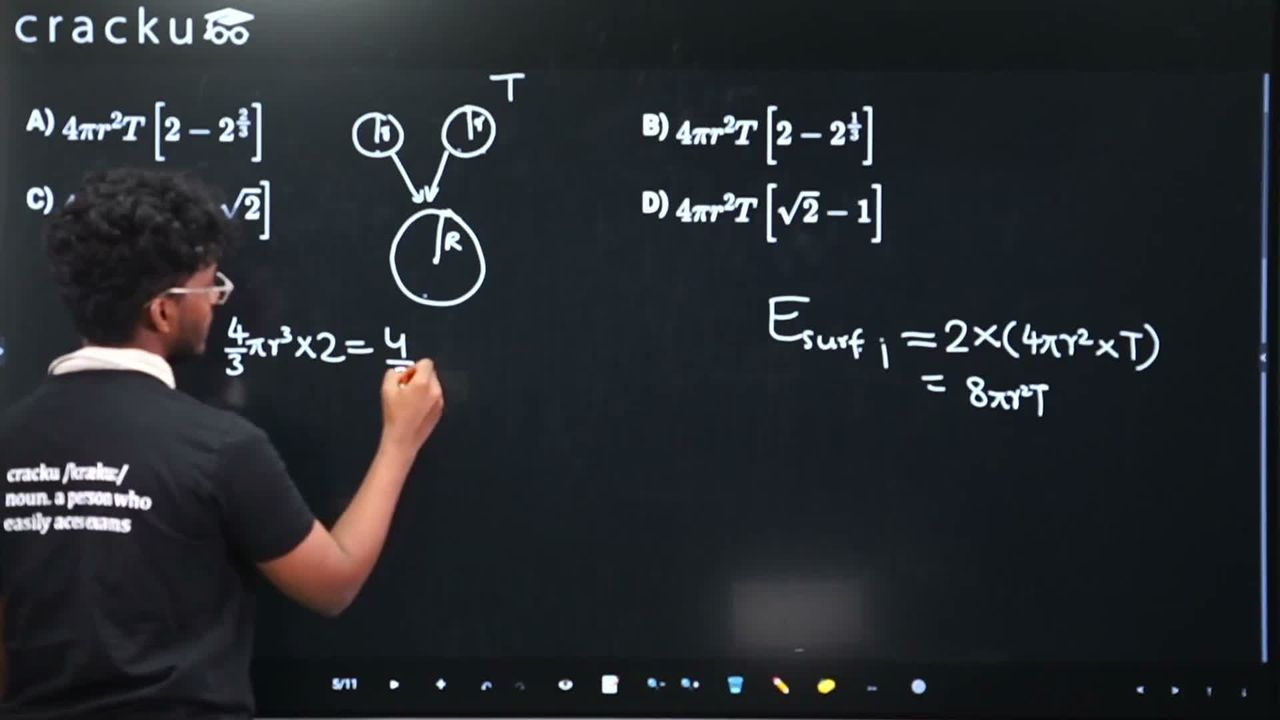
Two water drops each of radius 'r' coalesce to form a bigger drop. If 'T' is the surface tension, the surface energy released in this process is :
When a liquid drop is formed, its surface possesses energy equal to (surface tension) × (surface area).
Hence the change in surface energy equals the change in surface area multiplied by the surface tension $$T$$.
Step 1: Initial surface area
Two identical drops, each of radius $$r$$, have total surface area
$$A_i = 2 \times 4\pi r^{2} = 8\pi r^{2}$$
Step 2: Radius of the bigger drop after coalescence
Volume is conserved during coalescence.
Initial volume: $$V_i = 2 \times \frac{4}{3}\pi r^{3} = \frac{8}{3}\pi r^{3}$$
Let $$R$$ be the radius of the bigger drop.
Final volume: $$V_f = \frac{4}{3}\pi R^{3}$$
Equating volumes:
$$\frac{4}{3}\pi R^{3} = \frac{8}{3}\pi r^{3}$$
$$\Rightarrow R^{3} = 2\,r^{3}$$
$$\Rightarrow R = 2^{\frac{1}{3}}\,r$$
Step 3: Final surface area
$$A_f = 4\pi R^{2} = 4\pi \left(2^{\frac{1}{3}}r\right)^{2} = 4\pi r^{2}\,2^{\frac{2}{3}}$$
Step 4: Decrease in surface area
$$\Delta A = A_i - A_f = 8\pi r^{2} - 4\pi r^{2}\,2^{\frac{2}{3}}$$
Factorising:
$$\Delta A = 4\pi r^{2}\left[2 - 2^{\frac{2}{3}}\right]$$
Step 5: Surface energy released
Released energy $$E = T \times \Delta A$$
$$E = 4\pi r^{2}\,T \left[2 - 2^{\frac{2}{3}}\right]$$
Thus, the surface energy released is
$$\boxed{4\pi r^{2}T\left[2 - 2^{\frac{2}{3}}\right]}$$
Option A is correct.
Was this solution helpful?
Click on the Email ☝️ to Watch the Video Solution
Create a FREE account and get:
_1.webp)

Educational materials for JEE preparation

Ask our AI anything

AI can make mistakes. Please verify important information.
AI can make mistakes. Please verify important information.


