
Join Our JEE Preparation Group
Prep with like-minded aspirants; Get access to free daily tests and study material.
Sign in
Please select an account to continue using cracku.in
↓ →
Join Our JEE Preparation Group
Prep with like-minded aspirants; Get access to free daily tests and study material.
The X-Y plane be taken as the boundary between two transparent media $$M_1$$ and $$M_2$$. $$M_1$$ in $$Z \geq 0$$ has a refractive index of $$\sqrt{2}$$ and $$M_2$$ with $$Z < 0$$ has a refractive index of $$\sqrt{3}$$. A ray of light travelling in $$M_1$$ along the direction given by the vector $$\vec{A} = 4\sqrt{3}\hat{i} - 3\sqrt{3}\hat{j} - 5\hat{k}$$, is incident on the plane of separation. The value of difference between the angle of incident in $$M_1$$ and the angle of refraction in $$M_2$$ will be _____ degree.
Correct Answer: 15
We have the X-Y plane as the boundary between media $$M_1$$ ($$Z \geq 0$$, refractive index $$n_1 = \sqrt{2}$$) and $$M_2$$ ($$Z < 0$$, refractive index $$n_2 = \sqrt{3}$$). A ray travels in $$M_1$$ along the direction $$\vec{A} = 4\sqrt{3}\hat{i} - 3\sqrt{3}\hat{j} - 5\hat{k}$$.
The boundary is the X-Y plane, so the normal to the boundary is along the $$\hat{k}$$ direction. The angle of incidence is the angle between the ray and the normal to the surface. Since the ray has a negative $$k$$-component, it is moving toward the boundary (into the $$-z$$ direction).
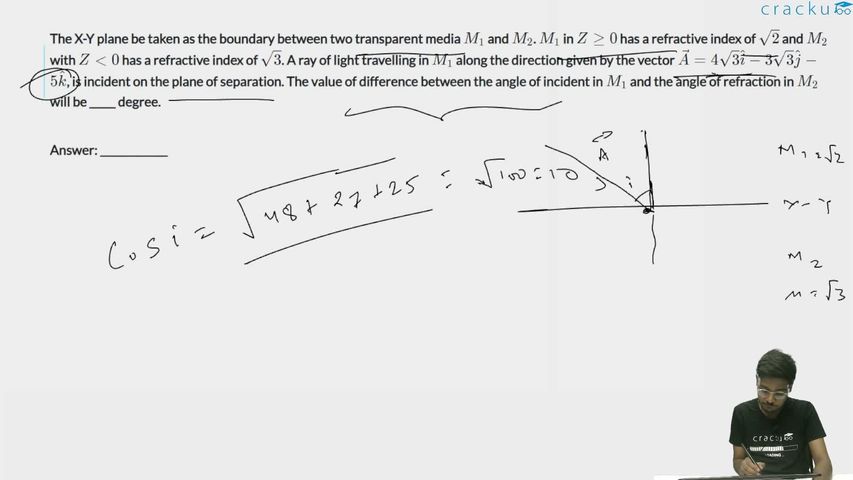
The magnitude of $$\vec{A}$$ is $$|\vec{A}| = \sqrt{(4\sqrt{3})^2 + (-3\sqrt{3})^2 + (-5)^2} = \sqrt{48 + 27 + 25} = \sqrt{100} = 10$$.
The component of the ray along the normal ($$-\hat{k}$$) direction has magnitude 5, and the component along the surface (in the X-Y plane) has magnitude $$\sqrt{48 + 27} = \sqrt{75} = 5\sqrt{3}$$.
The angle of incidence $$i$$ satisfies $$\cos i = \dfrac{|\text{component along normal}|}{|\vec{A}|} = \dfrac{5}{10} = \dfrac{1}{2}$$, so $$i = 60°$$.
Now applying Snell's law: $$n_1 \sin i = n_2 \sin r$$, so $$\sqrt{2} \sin 60° = \sqrt{3} \sin r$$. We get $$\sqrt{2} \times \dfrac{\sqrt{3}}{2} = \sqrt{3} \sin r$$, which simplifies to $$\dfrac{\sqrt{6}}{2} = \sqrt{3} \sin r$$, giving $$\sin r = \dfrac{\sqrt{6}}{2\sqrt{3}} = \dfrac{\sqrt{2}}{2} = \dfrac{1}{\sqrt{2}}$$. Therefore $$r = 45°$$.
The difference between the angle of incidence and the angle of refraction is $$i - r = 60° - 45° = 15°$$.
Hence, the correct answer is 15.
Was this solution helpful?
Click on the Email ☝️ to Watch the Video Solution
Create a FREE account and get:
_1.webp)

Educational materials for JEE preparation

Ask our AI anything

AI can make mistakes. Please verify important information.
AI can make mistakes. Please verify important information.
