
Join Our JEE Preparation Group
Prep with like-minded aspirants; Get access to free daily tests and study material.
Sign in
Please select an account to continue using cracku.in
↓ →
Join Our JEE Preparation Group
Prep with like-minded aspirants; Get access to free daily tests and study material.
An ideal gas of density $$\rho = 0.2$$ kg m$$^{-3}$$ enters a chimney of height h at the rate of $$\alpha = 0.8$$ kg s$$^{-1}$$ from its lower end, and escapes through the upper end as shown in the figure. The cross-sectional area of the lower end is $$A_1 = 0.1$$ m$$^2$$ and the upper end is $$A_2 = 0.4$$ m$$^2$$. The pressure and the temperature of the gas at the lower end are 600 Pa and 300 K, respectively, while its temperature at the upper end is 150 K. The chimney is heat insulated so that the gas undergoes adiabatic expansion. Take $$g = 10$$ ms$$^{-2}$$ and the ratio of specific heats of the gas $$\gamma = 2$$. Ignore atmospheric pressure.
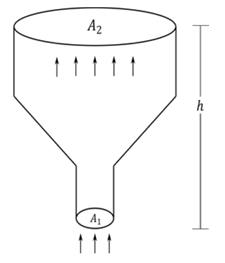
Which of the following statement(s) is(are) correct?
The mass flow rate is $$\alpha = 0.8 \text{ kg s}^{-1}$$. At the lower end: $$A_1 = 0.1 \text{ m}^2 , \; \rho_1 = 0.2 \text{ kg m}^{-3}$$.
1. Velocity at the lower end
Continuity gives $$\alpha = \rho_1 A_1 v_1 \; \Rightarrow \; v_1 = \frac{\alpha}{\rho_1 A_1} = \frac{0.8}{0.2 \times 0.1}=40 \text{ m s}^{-1}$$.
2. Gas constant and specific heat
Ideal-gas relation at the lower end: $$R_s = \frac{P_1}{\rho_1 T_1} = \frac{600}{0.2 \times 300}=10 \text{ J kg}^{-1}\text{K}^{-1}$$.
With $$\gamma = 2$$, $$C_p = \frac{\gamma R_s}{\gamma-1}= \frac{2 \times 10}{1}=20 \text{ J kg}^{-1}\text{K}^{-1}$$.
3. Density at the upper end from adiabatic relation
For an adiabatic (reversible) flow of an ideal gas
$$P\rho^{-\gamma}= \text{constant} \quad\Rightarrow\quad
\frac{P_1}{\rho_1^{\gamma}}=\frac{P_2}{\rho_2^{\gamma}} \; -(1)$$
The ideal-gas law also gives $$P_2 = \rho_2 R_s T_2$$.
Substitute into (1):
$$\frac{600}{(0.2)^2}= \frac{\rho_2 R_s T_2}{\rho_2^{2}}
\; \Longrightarrow\;
600\left(\frac{\rho_2}{0.2}\right)^2 = \rho_2 R_s T_2$$
$$\Rightarrow 600\frac{\rho_2^2}{0.04}= \rho_2(10)(150)$$
$$\Rightarrow 15000\,\rho_2 = 1500\,\rho_2 \; \Longrightarrow\; \rho_2 = 0.1 \text{ kg m}^{-3}$$.
4. Velocity at the upper end from continuity
$$v_2 = \frac{\alpha}{\rho_2 A_2}= \frac{0.8}{0.1 \times 0.4}=20 \text{ m s}^{-1}$$.
5. Pressure at the upper end
$$P_2 = \rho_2 R_s T_2 = 0.1 \times 10 \times 150 = 150 \text{ Pa}$$ (not 300 Pa).
6. Height of the chimney
Steady-flow energy equation for adiabatic flow (per unit mass):
$$C_p T + \frac{v^2}{2} + g z = \text{constant}$$
Between lower (1) and upper (2) ends:
$$C_p T_1 + \frac{v_1^2}{2}= C_p T_2 + \frac{v_2^2}{2}+ g h$$
$$20(300)+\frac{40^2}{2}=20(150)+\frac{20^2}{2}+10h$$
$$6000+800 = 3000+200+10h$$
$$10h = 3600 \;\Rightarrow\; h = 360 \text{ m}$$ (not 590 m).
7. Summary of the options
A. $$P_2 = 150\text{ Pa}\neq 300\text{ Pa}$$ ⇒ wrong.
B. $$v_1 = 40\text{ m s}^{-1},\; v_2 = 20\text{ m s}^{-1}$$ ⇒ correct.
C. Height obtained is 360 m, not 590 m ⇒ wrong.
D. $$\rho_2 = 0.1\text{ kg m}^{-3}\neq 0.05\text{ kg m}^{-3}$$ ⇒ wrong.
Hence, only Option B is correct.
Option B which is: The velocity of the gas at the lower end of the chimney is 40 ms$$^{-1}$$ and at the upper end is 20 ms$$^{-1}$$.
Was this solution helpful?
Create a FREE account and get:
_1.webp)

Educational materials for JEE preparation

Ask our AI anything

AI can make mistakes. Please verify important information.
AI can make mistakes. Please verify important information.
