
Join Our JEE Preparation Group
Prep with like-minded aspirants; Get access to free daily tests and study material.
Sign in
Please select an account to continue using cracku.in
↓ →
Join Our JEE Preparation Group
Prep with like-minded aspirants; Get access to free daily tests and study material.
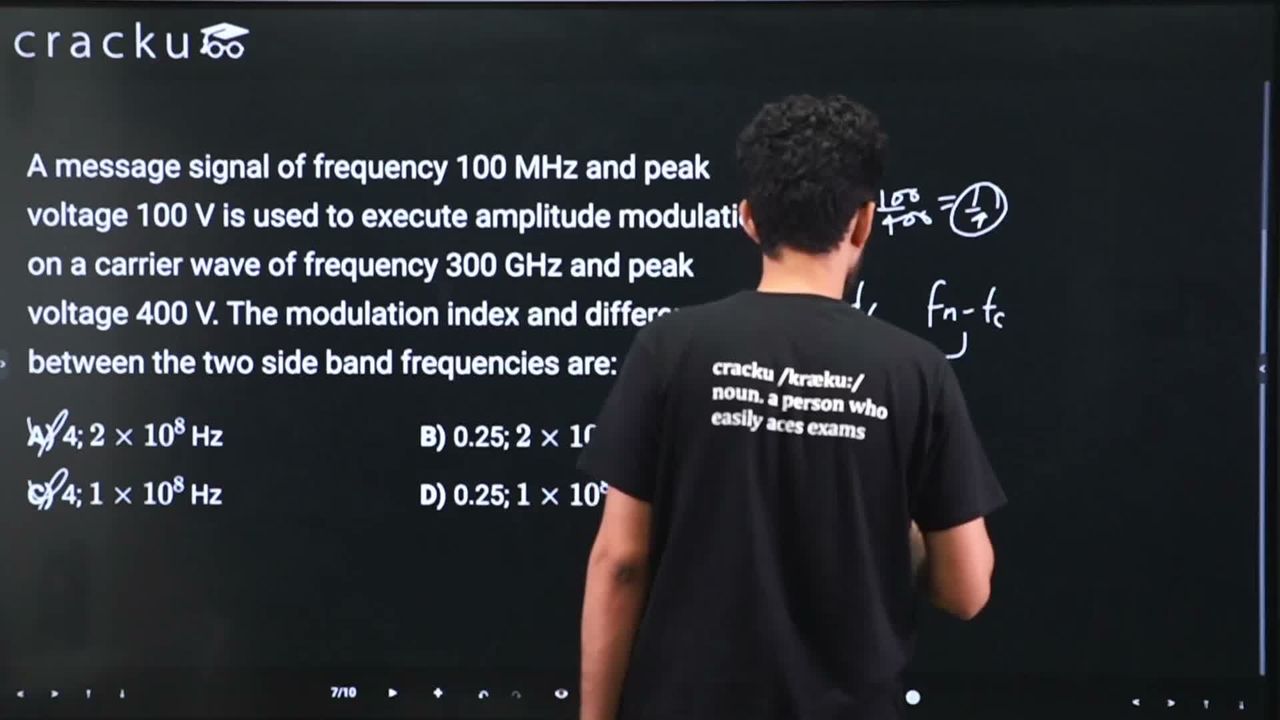
A message signal of frequency 100 MHz and peak voltage 100 V is used to execute amplitude modulation on a carrier wave of frequency 300 GHz and peak voltage 400 V. The modulation index and difference between the two side band frequencies are:
In amplitude modulation, the modulation index (also called the degree of modulation) is defined as the ratio of the peak value of the message (modulating) signal to the peak value of the carrier signal. Stating the formula, we have
$$m = \dfrac{V_{\text{m (peak)}}}{V_{\text{c (peak)}}}\,.$$
Here the peak voltage of the message signal is given as $$V_{\text{m (peak)}} = 100\ \text{V}$$ and the peak voltage of the carrier wave is $$V_{\text{c (peak)}} = 400\ \text{V}.$$ Substituting these values,
$$m = \dfrac{100\ \text{V}}{400\ \text{V}} = \dfrac{1}{4} = 0.25.$$
Now we consider the side-band frequencies. For ordinary amplitude modulation, the two side bands are produced at
$$f_{\text{USB}} = f_{\text{c}} + f_{\text{m}}, \qquad f_{\text{LSB}} = f_{\text{c}} - f_{\text{m}},$$
where $$f_{\text{c}}$$ is the carrier frequency and $$f_{\text{m}}$$ is the message (modulating) frequency. The difference between these two side-band frequencies is therefore
$$\Delta f = f_{\text{USB}} - f_{\text{LSB}}.$$
Substituting the expressions for $$f_{\text{USB}}$$ and $$f_{\text{LSB}}$$,
$$\Delta f = (f_{\text{c}} + f_{\text{m}}) - (f_{\text{c}} - f_{\text{m}}) = 2f_{\text{m}}.$$
The problem states $$f_{\text{m}} = 100\ \text{MHz} = 1 \times 10^{8}\ \text{Hz}.$$ Hence,
$$\Delta f = 2 \times 1 \times 10^{8}\ \text{Hz} = 2 \times 10^{8}\ \text{Hz}.$$
We have now obtained both required quantities: the modulation index is $$0.25$$ and the difference between the side-band frequencies is $$2 \times 10^{8}\ \text{Hz}$$.
Hence, the correct answer is Option B.
Was this solution helpful?
Click on the Email ☝️ to Watch the Video Solution
Create a FREE account and get:
_1.webp)

Educational materials for JEE preparation

Ask our AI anything

AI can make mistakes. Please verify important information.
AI can make mistakes. Please verify important information.
