
Join Our JEE Preparation Group
Prep with like-minded aspirants; Get access to free daily tests and study material.
Sign in
Please select an account to continue using cracku.in
↓ →
Join Our JEE Preparation Group
Prep with like-minded aspirants; Get access to free daily tests and study material.
Two cylindrical vessels of equal cross sectional area of $$2 \text{ m}^2$$ contain water upto height 10 m and 6 m, respectively. If the vessels are connected at their bottom, then the work done by the force of gravity is: (Density of water is $$10^3 \text{ kg/m}^3$$ and $$g = 10 \text{ m/s}^2$$)
Since the vessels have equal cross-sectional areas and are connected at the bottom, water will flow until the heights are equal. The total volume is conserved.
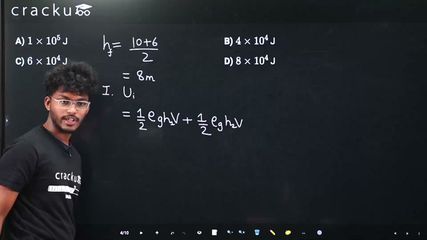
$$h_f = \frac{h_1 + h_2}{2} = \frac{10 + 6}{2} = 8 \text{ m}$$
The potential energy of a liquid column of mass $$M$$ and height $$h$$ is $$U = Mg\frac{h}{2}$$ (where $$h/2$$ is the center of mass). In terms of density ($$\rho$$) and area ($$A$$), this is $$U = \frac{1}{2} \rho Ag h^2$$.
$$U_i = \frac{1}{2} \rho Ag (h_1^2 + h_2^2)$$
$$U_i = \frac{1}{2} \times 10^3 \times 2 \times 10 \times (10^2 + 6^2) = 10^4 \times (100 + 36) = 136 \times 10^4 \text{ J}$$
$$U_f = \frac{1}{2} \rho Ag (h_f^2 + h_f^2) = \rho Ag h_f^2$$
$$U_f = 10^3 \times 2 \times 10 \times (8^2)$$
$$U_f = 2 \times 10^4 \times 64 = 128 \times 10^4 \text{ J}$$
$$W_g = U_i - U_f$$ (work done by gravity is the negative change in potential energy)
$$W_g = (136 - 128) \times 10^4 = 8 \times 10^4 \text{ J}$$
Was this solution helpful?
Click on the Email ☝️ to Watch the Video Solution
Create a FREE account and get:
_1.webp)

Educational materials for JEE preparation

Ask our AI anything

AI can make mistakes. Please verify important information.
AI can make mistakes. Please verify important information.
