
Join Our JEE Preparation Group
Prep with like-minded aspirants; Get access to free daily tests and study material.
Sign in
Please select an account to continue using cracku.in
↓ →
Join Our JEE Preparation Group
Prep with like-minded aspirants; Get access to free daily tests and study material.
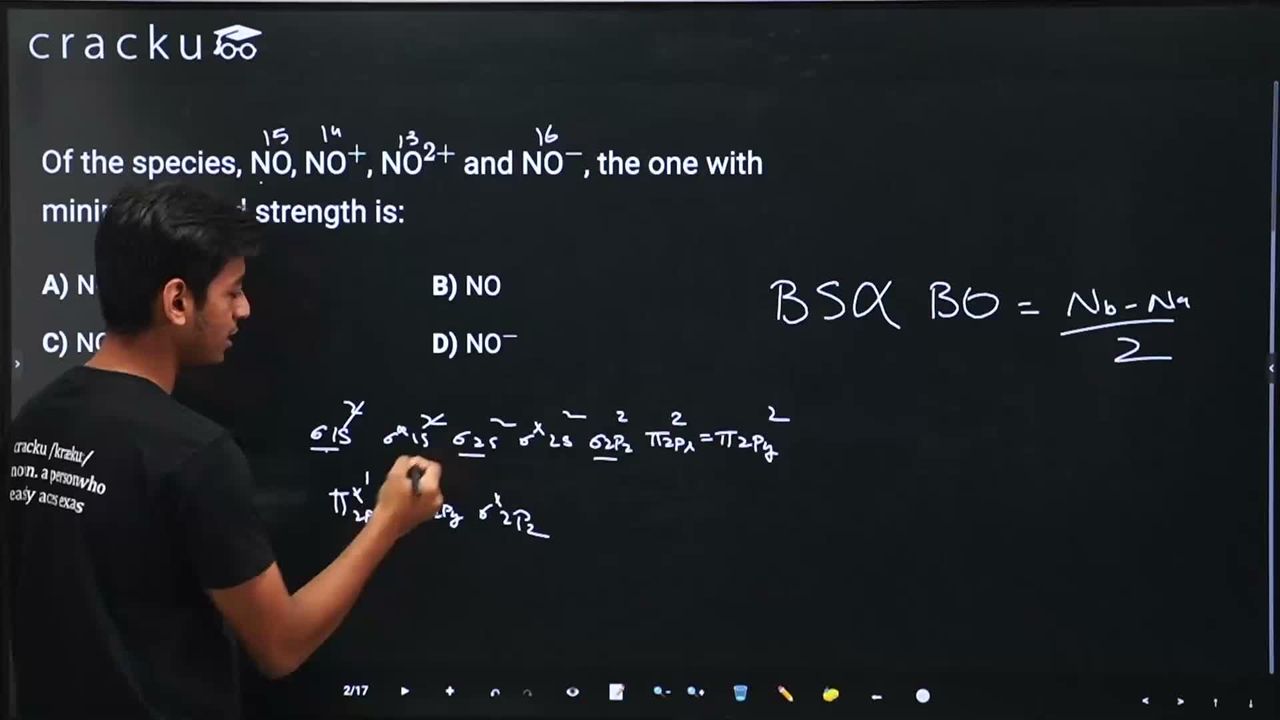
Of the species, NO, NO$$^+$$, NO$$^{2+}$$ and NO$$^-$$, the one with minimum bond strength is:
We have to compare the bond strengths of four related species. In Molecular Orbital (MO) theory, bond strength is directly connected with the bond order. A larger bond order means more bonding electrons (or fewer antibonding electrons), the bond becomes shorter and stronger; a smaller bond order means the bond is weaker.
The numerical relation is stated first:
$$$\text{Bond order} \; (B.O.) \;=\; \dfrac{N_b - N_a}{2}$$$
where $$N_b$$ is the total number of electrons present in bonding molecular orbitals and $$N_a$$ is the total number of electrons present in antibonding molecular orbitals.
For all second-period diatomic species (B$$_2$$ to N$$_2$$, O$$_2$$, F$$_2$$ and their ions) the order of the valence MOs that we must fill is the same:
$$$\sigma(2s)\,\lt \,\sigma^\*(2s)\,\lt \,\sigma(2p_z)\,\lt \,\pi(2p_x)=\pi(2p_y)\,\lt \,\pi^\*(2p_x)=\pi^\*(2p_y)\,\lt \,\sigma^\*(2p_z)$$$
Now we count the valence electrons in each species.
For atomic nitrogen, $$Z_N = 7$$, so $$N(2s^2 2p^3)$$ contributes $$5$$ valence electrons.
For atomic oxygen, $$Z_O = 8$$, so $$O(2s^2 2p^4)$$ contributes $$6$$ valence electrons.
Hence the neutral molecule NO has
$$$5 + 6 = 11 \text{ valence electrons.}$$$
Starting from this neutral 11-electron case, we can reach the ions simply by adding or removing electrons:
NO $$\; :\; 11 \text{ e}^-$$
NO$$^+$$ $$\; :\; 10 \text{ e}^-$$ (one electron removed)
NO$$^{2+}$$ $$: \; 9 \text{ e}^-$$ (two electrons removed)
NO$$^-$$ $$: \; 12 \text{ e}^-$$ (one electron added)
Now we place these electrons into the MO ladder one by one and calculate $$N_b$$ and $$N_a$$ every time. Because the first four electrons (two in $$\sigma(2s)$$ and two in $$\sigma^\*(2s)$$) cancel each other’s bonding effect, we can do the bookkeeping efficiently from the 5th electron onward, but for clarity every single filling step is shown.
(1) The neutral molecule NO - 11 electrons
$$$\sigma(2s)^2\;\; \sigma^\*(2s)^2\;\; \sigma(2p_z)^2\;\; \pi(2p_x)^2\;\; \pi(2p_y)^2\;\; \pi^\*(2p_x)^1$$$
Bonding electrons: $$N_b = 2 + 2 + 4 = 8$$
Antibonding electrons: $$N_a = 2 + 1 = 3$$
$$B.O._{\text{NO}} = \dfrac{8 - 3}{2} = \dfrac{5}{2} = 2.5$$
(2) The cation NO$$^+$$ - 10 electrons
The electron removed comes from the highest-energy occupied orbital of NO, i.e. the antibonding $$\pi^\*(2p)$$. So after removal:
$$$\sigma(2s)^2\;\; \sigma^\*(2s)^2\;\; \sigma(2p_z)^2\;\; \pi(2p_x)^2\;\; \pi(2p_y)^2$$$
Bonding electrons: $$N_b = 2 + 2 + 4 = 8$$
Antibonding electrons: $$N_a = 2$$
$$B.O._{\text{NO}^+} = \dfrac{8 - 2}{2} = 3$$
The bond order has increased, so the bond in NO$$^+$$ is stronger than in NO.
(3) The dication NO$$^{2+}$$ - 9 electrons
The second electron must now be removed from the next highest occupied MO, which is a bonding $$\pi(2p)$$ orbital. We therefore have:
$$$\sigma(2s)^2\;\; \sigma^\*(2s)^2\;\; \sigma(2p_z)^2\;\; \pi(2p_x)^2\;\; \pi(2p_y)^1$$$
Bonding electrons: $$N_b = 2 + 2 + (2+1) = 7$$
Antibonding electrons: $$N_a = 2$$
$$B.O._{\text{NO}^{2+}} = \dfrac{7 - 2}{2} = \dfrac{5}{2} = 2.5$$
The bond order comes back down to 2.5, the same as the neutral molecule.
(4) The anion NO$$^-$$ - 12 electrons
The extra electron has nowhere to go except the partially filled antibonding $$\pi^\*(2p)$$ level, giving:
$$$\sigma(2s)^2\;\; \sigma^\*(2s)^2\;\; \sigma(2p_z)^2\;\; \pi(2p_x)^2\;\; \pi(2p_y)^2\;\; \pi^\*(2p_x)^2$$$
Bonding electrons: $$N_b = 2 + 2 + 4 = 8$$
Antibonding electrons: $$N_a = 2 + 2 = 4$$
$$B.O._{\text{NO}^-} = \dfrac{8 - 4}{2} = 2$$
Now we compile the bond orders:
$$$\text{NO}^{2+} : 2.5,\quad \text{NO}^+ : 3,\quad \text{NO} : 2.5,\quad \text{NO}^- : 2$$$
The smallest bond order is $$2$$, which belongs to NO$$^-$$. Because bond strength decreases as bond order decreases, the species with the minimum bond strength is the anion NO$$^-$$.
Hence, the correct answer is Option D.
Was this solution helpful?
Click on the Email ☝️ to Watch the Video Solution
Create a FREE account and get:
_1.webp)

Educational materials for JEE preparation

Ask our AI anything

AI can make mistakes. Please verify important information.
AI can make mistakes. Please verify important information.
