
Join Our JEE Preparation Group
Prep with like-minded aspirants; Get access to free daily tests and study material.
Sign in
Please select an account to continue using cracku.in
↓ →
Join Our JEE Preparation Group
Prep with like-minded aspirants; Get access to free daily tests and study material.
A circular conducting coil of radius 1 m is being heated by the change of magnetic field $$\vec{B}$$ passing perpendicular to the plane in which the coil is laid. The resistance of the coil is 2 $$\mu\Omega$$. The magnetic field is slowly switched off such that its magnitude changes in time as
$$B = \frac{4}{\pi} \times 10^{-3} T\left(1 - \frac{t}{100}\right)$$
The energy dissipated by the coil before the magnetic field is switched off completely is $$E =$$ ___ mJ.
Correct Answer: 80
We begin with the given data. The circular coil has radius $$r = 1\ \text{m}$$, so its area is obtained from the usual formula for the area of a circle, $$A = \pi r^{2}$$. Substituting the radius we get $$A = \pi \times (1)^{2} = \pi\ \text{m}^{2}.$$
The resistance of the coil is stated to be $$R = 2\ \mu\Omega = 2 \times 10^{-6}\ \Omega.$$
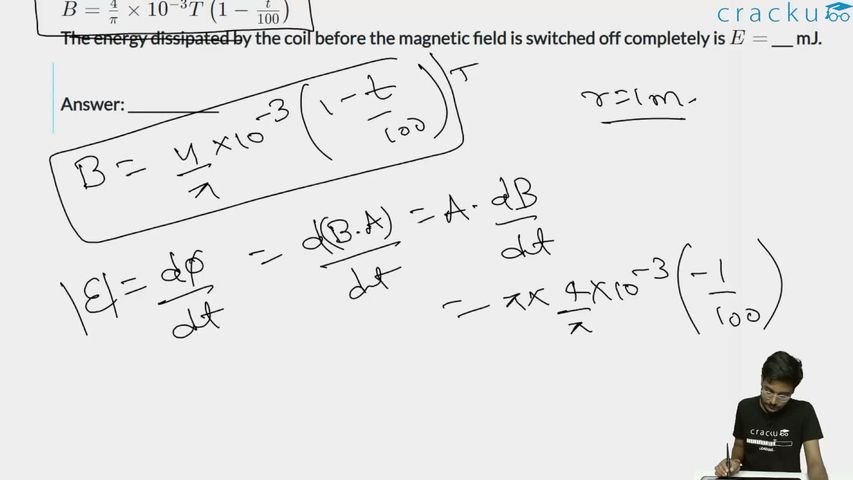
The magnetic field perpendicular to the plane of the coil is turned off slowly according to the time-dependent expression $$B(t) = \frac{4}{\pi}\times 10^{-3}\ \text{T}\,\Bigl(1 - \frac{t}{100}\Bigr).$$ The switch-off process lasts until $$t = 100\ \text{s},$$ at which instant the field becomes zero.
The magnetic flux $$\Phi$$ through the single-turn coil is given by the definition $$\Phi = B\,A.$$ Hence, $$\Phi(t) = \bigl[\tfrac{4}{\pi}\times 10^{-3}\,(1 - \tfrac{t}{100})\bigr]\;(\pi).$$
We now compute the induced emf using Faraday’s law. First we need the rate of change of magnetic field. Differentiating $$B(t)$$ with respect to time,
$$\frac{dB}{dt} = \frac{4}{\pi}\times 10^{-3} \,\Bigl(-\frac{1}{100}\Bigr) = -\,\frac{4}{\pi}\times 10^{-5}\ \text{T s}^{-1}.$$
The negative sign merely indicates the direction of change; for the magnitude we note
$$\left|\frac{dB}{dt}\right| = \frac{4}{\pi}\times 10^{-5}\ \text{T s}^{-1}.$$
Faraday’s law for a single loop is $$\mathcal{E} = -\,\frac{d\Phi}{dt} = -\,A\,\frac{dB}{dt}.$$ Taking the magnitude,
$$\mathcal{E} = A\,\left|\frac{dB}{dt}\right| = (\pi)\,\Bigl(\frac{4}{\pi}\times 10^{-5}\Bigr) = 4 \times 10^{-5}\ \text{V}.$$
Because $$\frac{dB}{dt}$$ is a constant, the induced emf $$\mathcal{E}$$ is also constant over the entire interval from $$t = 0$$ to $$t = 100\ \text{s}.$$
Ohm’s law gives the induced current: $$I = \frac{\mathcal{E}}{R}.$$ Substituting the numerical values,
$$I = \frac{4 \times 10^{-5}}{2 \times 10^{-6}} = 20\ \text{A}.$$
This current too remains constant during the 100-second interval. The electrical power dissipated as heat in the coil is given by the Joule-heating relation $$P = I^{2}R.$$ Hence,
$$P = (20)^{2}\,(2 \times 10^{-6}) = 400 \times 2 \times 10^{-6} = 8 \times 10^{-4}\ \text{W}.$$
Finally, the total energy $$E$$ dissipated in the entire interval is the product of power and time: $$E = P\,\Delta t$$ with $$\Delta t = 100\ \text{s}.$$
$$E = (8 \times 10^{-4})\,(100) = 8 \times 10^{-2}\ \text{J}.$$
Because $$1\ \text{J} = 1000\ \text{mJ},$$ we convert:
$$E = 8 \times 10^{-2}\ \text{J} = 0.08\ \text{J} = 80\ \text{mJ}.$$
Hence, the correct answer is Option C.
Was this solution helpful?
Click on the Email ☝️ to Watch the Video Solution
Create a FREE account and get:
_1.webp)

Educational materials for JEE preparation

Ask our AI anything

AI can make mistakes. Please verify important information.
AI can make mistakes. Please verify important information.
