
Join Our JEE Preparation Group
Prep with like-minded aspirants; Get access to free daily tests and study material.
Sign in
Please select an account to continue using cracku.in
↓ →
Join Our JEE Preparation Group
Prep with like-minded aspirants; Get access to free daily tests and study material.
The stopping potential V$$_0$$ (in volt) as a function of frequency ($$\nu$$) for a sodium emitter, is shown in the figure. The work function of sodium, from the data plotted in the figure, will be:
(Given: Planck's constant h = $$6.63 \times 10^{-34}$$ J s, electron charge (e) = $$1.6 \times 10^{-19}$$ C)
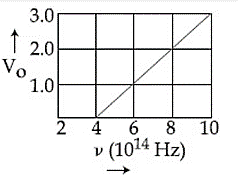
The fundamental relation governing the photo-electric effect is Einstein’s photo-electric equation, which we first state in its usual form:
$$e\,V_{0}=h\,\nu-\phi$$
Here $$e$$ is the electronic charge, $$V_{0}$$ is the stopping potential, $$h$$ is Planck’s constant, $$\nu$$ is the frequency of the incident light and $$\phi$$ is the work function of the emitter.
Re-arranging the equation to express $$V_{0}$$ as a function of $$\nu$$, we obtain
$$V_{0}=\frac{h}{e}\,\nu-\frac{\phi}{e}$$
Thus a graph of $$V_{0}$$ (vertical axis) versus $$\nu$$ (horizontal axis) must be a straight line whose:
• slope is $$\dfrac{h}{e}$$, and
• intercept on the frequency axis (where $$V_{0}=0$$) is the threshold frequency $$\nu_{0}$$ given by $$h\,\nu_{0}=\phi$$.
Looking carefully at the plotted data in the given figure, we see that the straight line meets the frequency axis (that is, $$V_{0}=0$$) at
$$\nu_{0}=4.0\times10^{14}\,\text{Hz}$$
Now we can calculate the work function. Putting $$\nu=\nu_{0}$$ in $$h\,\nu_{0}=\phi$$, we have
$$\phi=h\,\nu_{0}$$
Substituting the numerical values
$$h=6.63\times10^{-34}\,\text{J\,s}$$ and $$\nu_{0}=4.0\times10^{14}\,\text{Hz}$$, we get
$$\phi=(6.63\times10^{-34})(4.0\times10^{14})$$
$$\phi=2.652\times10^{-19}\,\text{J}$$
To express the result in electron-volts, we divide by the charge of one electron $$e=1.6\times10^{-19}\,\text{C}$$ (remembering that 1 eV = $$1.6\times10^{-19}$$ J):
$$\phi=\frac{2.652\times10^{-19}\,\text{J}}{1.6\times10^{-19}\,\text{J/eV}}=1.658\,\text{eV}$$
Rounding to the number of significant figures consistent with the given data,
$$\phi\approx1.66\,\text{eV}$$
Hence, the correct answer is Option D.
Was this solution helpful?
Create a FREE account and get:
_1.webp)

Educational materials for JEE preparation

Ask our AI anything

AI can make mistakes. Please verify important information.
AI can make mistakes. Please verify important information.
