
Join Our JEE Preparation Group
Prep with like-minded aspirants; Get access to free daily tests and study material.
Sign in
Please select an account to continue using cracku.in
↓ →
Join Our JEE Preparation Group
Prep with like-minded aspirants; Get access to free daily tests and study material.
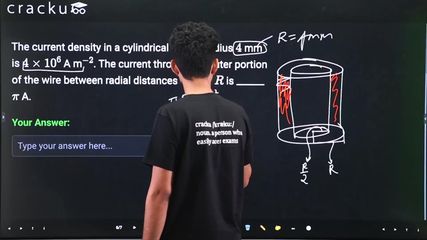
The current density in a cylindrical wire of radius $$4$$ mm is $$4 \times 10^6$$ A m$$^{-2}$$. The current through the outer portion of the wire between radial distances $$\frac{R}{2}$$ and $$R$$ is ______ $$\pi$$ A.
Correct Answer: 48
We need to find the current through the outer portion of a cylindrical wire between radial distances R/2 and R, where R = 4 mm and the current density J = $$4 \times 10^6$$ A/m². Because the current density is uniform, the total current is given by $$I = J \times A$$, where A is the area of the annular region between R/2 and R.
To determine this area, note that $$A = \pi R^2 - \pi \left(\frac{R}{2}\right)^2 = \pi R^2 - \frac{\pi R^2}{4} = \frac{3\pi R^2}{4}$$.
Here, $$R = 4 \text{ mm} = 4 \times 10^{-3} \text{ m}$$. Substituting into the expression for the current gives
$$I = J \times \frac{3\pi R^2}{4} = 4 \times 10^6 \times \frac{3\pi \times (4 \times 10^{-3})^2}{4}$$
$$I = 4 \times 10^6 \times \frac{3\pi \times 16 \times 10^{-6}}{4}$$
$$I = 4 \times 10^6 \times 12\pi \times 10^{-6}$$
$$I = 48\pi \text{ A}$$
The current through the outer portion is 48$$\pi$$ A.
Was this solution helpful?
Click on the Email ☝️ to Watch the Video Solution
Create a FREE account and get:
_1.webp)

Educational materials for JEE preparation

Ask our AI anything

AI can make mistakes. Please verify important information.
AI can make mistakes. Please verify important information.
