
Join Our JEE Preparation Group
Prep with like-minded aspirants; Get access to free daily tests and study material.
Sign in
Please select an account to continue using cracku.in
↓ →
Join Our JEE Preparation Group
Prep with like-minded aspirants; Get access to free daily tests and study material.
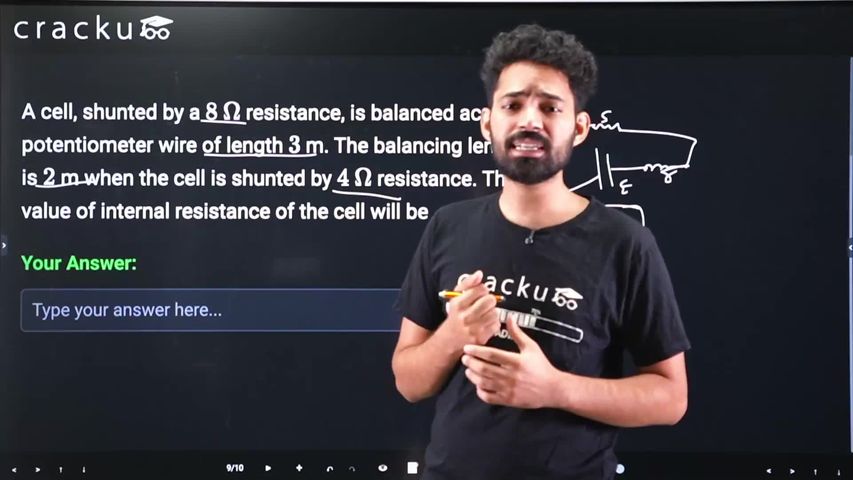
A cell, shunted by a $$8$$ $$\Omega$$ resistance, is balanced across a potentiometer wire of length $$3$$ m. The balancing length is $$2$$ m when the cell is shunted by $$4$$ $$\Omega$$ resistance. The value of internal resistance of the cell will be ______ $$\Omega$$.
Correct Answer: 8
A cell with internal resistance r is balanced using a potentiometer. When shunted by 8 Ω, the balancing length is some value, and when shunted by 4 Ω, the balancing length is 2 m (out of total 3 m wire).
When a cell of EMF E and internal resistance r is shunted by resistance S, the terminal voltage is:
$$V = \frac{ES}{r + S}$$
The balancing length is proportional to the terminal voltage; let k be the potential gradient. For a shunt of $$S_1 = 8$$ Ω with balancing length $$l_1$$, we have
$$\frac{8E}{r + 8} = k \cdot l_1$$
For a shunt of $$S_2 = 4$$ Ω with balancing length $$l_2 = 2$$ m, it follows that
$$\frac{4E}{r + 4} = k \cdot 2$$
Since the balancing length for the 8 Ω shunt spans the entire 3 m potentiometer wire (a higher shunt resistance yields a higher terminal voltage, requiring the full length),
$$\frac{8E}{r + 8} = k \cdot 3$$
Dividing the equation for the 8 Ω shunt by that for the 4 Ω shunt gives
$$\frac{8E/(r+8)}{4E/(r+4)} = \frac{3}{2}$$
This ratio simplifies as follows:
$$\frac{8(r+4)}{4(r+8)} = \frac{3}{2}$$
$$\frac{2(r+4)}{r+8} = \frac{3}{2}$$
$$4(r+4) = 3(r+8)$$
$$4r + 16 = 3r + 24$$
$$r = 8 \text{ } \Omega$$
The internal resistance of the cell is 8 Ω.
Was this solution helpful?
Click on the Email ☝️ to Watch the Video Solution
Create a FREE account and get:
_1.webp)

Educational materials for JEE preparation

Ask our AI anything

AI can make mistakes. Please verify important information.
AI can make mistakes. Please verify important information.
